
As ASEAN regulatory bodies aggressively standardize digital sovereignty—mirrored by dual-governance crackdowns like Indonesia’s ‘T3’ AI framework—corporate communications in Vietnam faces an immediate statutory reckoning. Ahead of the July 1, 2026 Press Law enforcement deadline eliminating journalist source confidentiality, brands operating in Hanoi and Ho Chi Minh City face unprecedented exposure. Navigating this contracted landscape requires shifting PR from a top-of-funnel visibility exercise directly into boardroom legal governance.
While our baseline 2026 diagnostic – The “Control Illusion”: Why Your Vietnam PR Strategy Needs a Reset for 2026 – examined the structural contraction of Vietnam’s newsrooms, this follow-up advisory establishes the non-negotiable legal, procurement, and live-stream protocols required to shield enterprise product claims within it.
Vietnam’s media landscape is undergoing a massive, state-mandated contraction that fundamentally rewrites commercial communication strategies. The National Press Development and Management Planning policy has dramatically consolidated the media landscape, forcing numerous organizations to close and triggering widespread job losses among journalists and editorial staff.
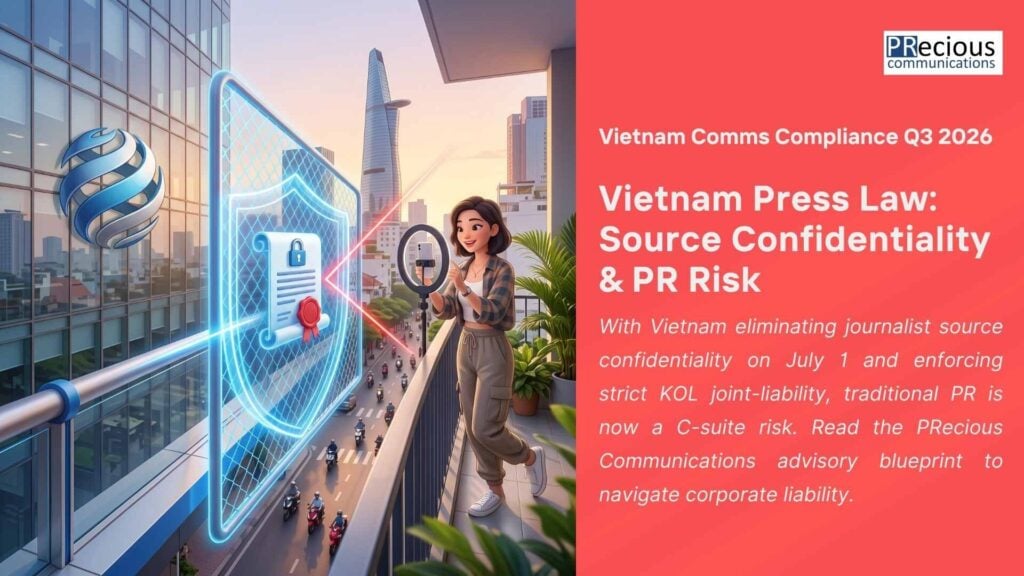
This aggressive restructuring enforces a new core thesis for multinational corporations (MNCs): media relations in Vietnam has shifted entirely from a “reputation and visibility” exercise to a high-stakes “corporate compliance and legal liability” function. Facing heavy government fines, corporate channel suspensions, and extreme regulatory scrutiny, brands can no longer rely on volume-based earned media; communication strategies must now be architected with legal compliance as the foundational starting point.
The Death of Transactional PR & the Tri-Anchor Solution
The targeted shutdown of 180 media outlets has decimated the mid-tier earned media ecosystem, marking the death of transactional, volume-based “spray and pray” press release distribution. The remaining newsrooms operate under extreme staffing constraints and high ideological scrutiny, rendering traditional PR pitches obsolete unless they are paired with primary data and hyper-localized context.
To navigate this restricted environment, PRecious Communications deploys the “Tri-Anchor Model” for MNCs in Hanoi and Ho Chi Minh City, bypassing traditional media relations for a unified ecosystem communication strategy:
- Anchor 1: Paid/Hybrid State Megamedia: We establish foundational institutional legitimacy by securing paid, custom advertorial hubs on the remaining Tier-1 state megamedia platforms (e.g., VnExpress, VNA).
- Anchor 2: Owned, Live-Moderated Social Commerce Ecosystems: We pivot product-focused narratives to platforms like Zalo and TikTok Shop, focusing strictly on direct-to-consumer utility. These channels require aggressive, real-time corporate compliance moderation to neutralize algorithmic outrage.
- Anchor 3: Generative Engine Optimization (GEO): With mainstream options heavily consolidated and traditional trade newsrooms shrinking, we optimize all corporate text assets for AI search engines (GEO). This ensures that consumers looking for brand discovery and recommendations bypass volatile public digital spaces and find the brand directly via search algorithms.
Rewriting the Influencer Compliance Paradigm (Law No. 75/2025/QH15)
Vietnam’s Amended Advertising Law (Law No. 75/2025/QH15), effective January 1, 2026, radically alters the influencer ecosystem by legally defining Key Opinion Leaders (KOLs) and Key Opinion Consumers (KOCs) as independent “Advertisement Conveyors”. Influencers are now independently liable for deceptive scripts, and brands face joint legal prosecution for unverified claims.
To shield MNCs from joint liability, administrative fines, and regulatory penalties, PRecious Communications structurally embeds four non-negotiable clauses into all client-vendor talent contracts:
- Prior Usage Attestation: Influencers must explicitly warrant that they have personally used and possess a comprehensive understanding of the product prior to promotion, maintaining visual or written evidence for regulatory requests.
- Continuous Ad Tagging: Contractual mandate to use un-obscured visual and textual indicators (such as the native platform’s #quangcao tag) continuously throughout the duration of any livestream or digital post.
- Independent Regulatory Verification: Influencers are legally obligated to review and independently verify all Ministry of Health approvals and product clearance certificates against government registries prior to publication.
- 12-Hour Takedown SLA: A strict Service Level Agreement requiring influencers to completely delete or unpublish flagged content within 12 hours of an authority or brand notice, coupled with an indemnity clause holding the influencer liable for non-compliance fines.
State Secrets & Cybersecurity: The New Boundaries of Crisis Management
Corporate communicators are facing unprecedented legal boundaries under the overhauled Cybersecurity Law and the Protection of State Secrets Bill. MNCs must map out strict corporate “no-go zones,” as publishing commentary on land settlements, state compensation, international trade friction, and unverified product health claims violates state law and triggers severe corporate penalties.
Furthermore, the July 1, 2026 Press Law amendment legally eliminates source confidentiality, empowering local police and the Ministry of Public Security to force journalists to hand over source data for alleged infractions. Traditional media relations strategies are now a liability; internal corporate leaks sent to reporters can be traced directly back to company servers, exposing MNCs to state crackdowns.
To manage algorithmic volatility, PRecious Communications architects a “Real-Time Live-Stream Crisis Protocol” tailored for social commerce events:
- Automation Filters: Implementing system-level keyword matches to instantly block comments containing flagged political terms or restricted state secrets.
- Manual Triage: Routing subtle or highly emotional commercial complaints to an agency moderator panel to determine whether the issue is an isolated event or a coordinated algorithmic attack.
- 12-Hour Takedown Execution: In the event of a systemic crisis, executing a “Hoist Engine Protocol” to immediately kill the stream and scrub the Video-on-Demand (VOD) from the platform within the statutory 12-hour compliance window.
Advisory Call to Action for MNCs
C-suite executives, legal counsel, and procurement officers must urgently evaluate their current agency vendors in Vietnam against the 2026 legal framework. We advise implementing this three-step immediate audit checklist:
- Licensing & Cross-Border Registration Audit: Ensure the agency holds explicit “Advertising Services” and “Public Relations Services” business codes, and confirm they hold valid Ministry of Information and Communications (MIC) permits for hosting localized digital forums.
- KOL/KOC Management Infrastructure: Audit standard talent contracts for the new statutory clauses (Prior Usage Attestation, Mandatory Ad Tagging, Regulatory Verification Warrants) and confirm the agency utilizes an internal compliance officer for mandatory script reviews against state certifications.
- Data Privacy, Cybersecurity, & Financial Accountability: Verify onshore data storage compliance for consumer data, check Master Service Agreements (MSAs) for forced source disclosure indemnities, and validate that the agency can execute the mandatory 12-Hour Takedown SLA while assuming financial liability for administrative fines triggered by unvetted claims.
Navigating Vietnam’s New Regulatory Reality: A Strategic Risk Assessment
Legacy PR strategies—such as high-volume press release distribution, passive influencer endorsements, and reactive crisis timelines—now expose brands to joint prosecution, immediate content takedowns, severe financial penalties, and state-level data audits. To survive in this highly controlled information ecosystem, enterprise communicators must transition from a posture of passive media relations to active, compliance-driven operational control.
The following 1-Page Risk Matrix contrasts the severe vulnerabilities of legacy PR methods against the risk-intelligent solutions of the Tri-Anchor Governance Model, mapping each transition directly to its statutory legal framework for Q3 2026.
| Risk Factor | Legacy PR Approach (Pre-2026) | New Tri-Anchor Solutions (Q3 2026) | Regulatory Exposure & Legal Basis |
| Media Distribution | “Spray & Pray” Releases: Mass-pitching corporate copy to mid-tier trade newsrooms for high-volume backlink and clipping generation. | Anchor 1: Paid State Megamedia: High-credibility, custom advertorial hubs limited to remaining Tier-1 networks (VnExpress, VNA) paired with original primary data. | Media Contraction: Closure of 180+ media outlets eliminates mid-tier visibility. Extreme ideological scrutiny rejects unverified or purely commercial corporate text. |
| Press & Article Sharing | Unlicensed Amplification: Clipping, screenshotting, or copying full press articles onto corporate social media channels without express publisher permission. | Content Integrity & Original Summaries: Removing historical media links; generating original summaries or securing direct, written licensing agreements from publishers. | Decree No. 174/2026/ND-CP: Levies fines up to 30M VND per infraction for sharing press works without written consent; criminalizes “fake news” impacting markets. |
| Influencer Marketing | Scripted Endorsements: Treating KOLs/KOCs as passive script readers with light brand-only indemnification contracts. | Contractual Liability Shielding: Embedding four mandatory clauses into talent contracts (Prior Usage, Continuous Ad Tagging, 12-Hr SLA, Registry Verification). | Law No. 75/2025/QH15 (Amended Advertising Law): Legalizes KOLs as “Advertisement Conveyors,” imposing joint civil and criminal liability on brands and talent for false claims. |
| Data Privacy & Tracking | Unrestricted Pixels: Deploying marketing pixels and third-party tracking cookies (Google/Meta) that activate automatically upon page load. | Anchor 2 & Zero-Consent Hardening: Redirecting commercial activity to lived-moderated social commerce (Zalo, TikTok Shop) and halting web tracking prior to explicit user opt-in. | Personal Data Protection Law (PDPL): Full enforcement mandates explicit prior consent; corporate sites loading tracking infrastructure beforehand face high-risk data audits. |
| Discovery & Search Visibility | SEO Backlink Building: Relying on standard web keyword density and organic indexing across traditional trade forums. | Anchor 3: Generative Engine Optimization (GEO): Structuring corporate text assets for AI search engines to bypass volatile, state-monitored public digital spaces. | Information Restructuring: Traditional media consolidation minimizes standard SEO index targets; consumers shift to AI-driven, direct brand recommendation algorithms. |
| Corporate Leakage | Confidential Whispers: Utilizing anonymous whistleblowers or leaking internal corporate positioning documents to trusted investigative journalists. | Source Data Containment: Securing all internal communications on enterprise-grade servers; treating media engagement strictly as an institutional paper trail. | 2026 Press Law Amendment: Legally eliminates source confidentiality. Local police and the Ministry of Public Security can force journalists to hand over source metadata. |
| Crisis Management | Reactive PR Statements: Issuing carefully worded corporate statements 24 to 48 hours after an online controversy or algorithmic outrage occurs. | Real-Time Live-Stream Protocol: Deploying systemic keyword filters to instantly block restricted political terms, backed by an agency panel for manual triage. | Cybersecurity Law & Protection of State Secrets: Severe penalties for platforms allowing real-time public commentary on land settlements, state compensation, or unverified health claims. |
| Emergency Containment | Prolonged Mitigation: Leaving disputed corporate live streams or promotional VOD content online while legal and public relations teams deliberate. | The “Hoist Engine Protocol”: Enforcing a mandatory contract SLA to completely scrub or unpublish flagged online content across all channels within a strict 12-hour window. | Statutory Takedown SLA: Strict administrative mandates demand immediate removal of content flagged by authorities as harmful to socioeconomic stability or national cybersecurity. |
Secure Your Brand’s Operational Future in Vietnam
The era of treating regulatory compliance as a secondary legal checklist is over. In Vietnam’s highly scrutinized and rapidly consolidating informational landscape, continuing to rely on outdated, transactional PR tactics invites immediate administrative sanctions, public reputational damage, and severe corporate exposure. As the rigid enforcement of Decree No. 174, Law No. 75, and strict PDPL mandates takes hold this quarter, the gap between traditional media relations and risk-intelligent market execution will define the market survivors. C-suite executives, legal counsel, and procurement officers cannot afford to wait for a regulatory audit or an algorithmic crisis to evaluate their operational vulnerabilities.
PRecious Communications, APAC’s Most Innovative PR and Comms Agency, stands ready as your indispensable, risk-intelligent partner in Vietnam. With an established on-the-ground presence, we possess the precise operational architecture, audited talent networks, and strategic foresight required to transition your brand seamlessly into the Tri-Anchor Governance framework. Do not leave your organization exposed to joint liability, forced source disclosures, or catastrophic data compliance failures.
Contact PRecious Communications today to schedule an immediate compliance audit of your current agency vendors, deploy our certified KOL contract riders, and secure your brand’s operational future in Vietnam.
Contact the PRecious team today to discuss your communications strategy.