The Grand Ballroom of the Pullman Jakarta Indonesia Thamrin CBD was filled with an unusual, quiet excitement and anticipation at the inaugural PR Asia Indonesia 2026 summit. The conversations among the region’s chief marketing officers and communications trailblazers were not about standard media clips or press release distribution. Instead, they centered on a profound, systemic challenge: how did a brand maintain its reputation and influence when consumers stopped clicking on search links entirely?
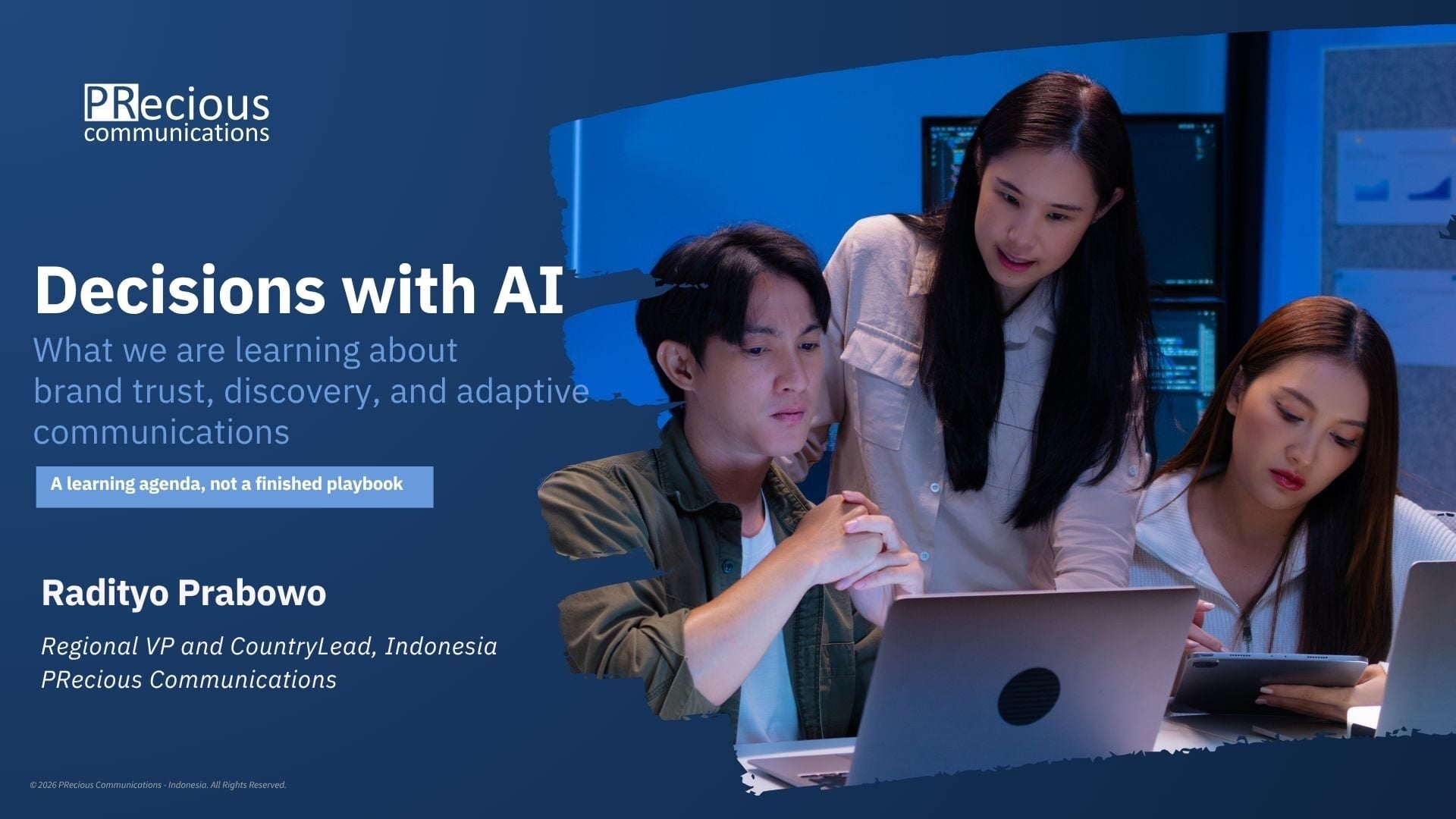
This shift in consumer behavior was no longer a distant projection. Radityo Prabowo, Regional VP and Country Lead for Indonesia at PRecious Communications, set the tone for this collective reflection during his keynote. He emphasized that this was not a finished playbook, but a shared learning agenda that communicators, brands, and media had to navigate together.
Get the Full Presentation on Decisions with AI: What we are learning about brand trust, discovery, and adaptive communications.
The Strategic Summary
- Consumers are increasingly bypassing traditional search links for direct, AI-synthesized recommendations, creating a “silent consideration loop” where brands must be influential even when they are not directly present during the decision process.
- To maintain reputation, brands must move from a “control” mindset to one of “coherence,” ensuring their owned, earned, and ecosystem signals are aligned to prevent contradictory “data noise” that causes AI systems to discard the brand.
- Effective reputation management now requires model-specific, localized strategies, as different conversational platforms—including Claude, GPT-5.1, Perplexity, and Gemini—rely on distinct trust vectors and sourcing patterns.
- The newly launched PRecious Pulse provides a diagnostic approach for brands to audit their digital footprint, analyze evidence strength, and transition from transactional media tracking to systemic reputation design.
The Silent Consideration Loop: Influence in a “Clickless” Landscape
For decades, the path a consumer took to discover and evaluate a brand followed a predictable route. A buyer searched for options, curated their own shortlist of links, and decided later. That journey became heavily compressed. Consumers increasingly bypassed standard search boxes to ask digital assistants for a direct, synthesized recommendation.
Consider the real-world purchase decision shared during the keynote: Radityo himself typed a conversational query into an AI assistant, looking for a smartphone under 5 million Rupiah with a clean user interface, long battery life, NFC support, and long-term software updates. The assistant did not present ten blue links. Instead, it scanned fifteen distinct web sources—including review portals like Gizmologi and TechRadar, and local forums like VCGamers and Reddit—and returned a single recommendation: the ZTE Nubia V60 NFC. Radityo, who had never previously considered ZTE, took a leap of faith and bought the phone.
The critical detail of this transaction was that the manufacturer’s owned website was never evaluated in the machine’s citation stack. The system formulated its entire recommendation, verified specifications, and established pricing strictly through third-party earned media and community channels.
This was the silent consideration loop. The question for modern brands was no longer whether they could be found via keywords. The question was: what was the machine learning—and saying—about your brand when your team was not in the room?
Coherence Over Control: Embracing the Multi-Source Ecosystem
The instinct of traditional communications had always been control, drafting a sterile corporate statement and projecting it outward. But in a digital environment where search engines and recommendation platforms synthesized answers from thousands of scattered web pages, control was a relic.
The new operational standard was coherence. Machine systems did not evaluate a brand in isolation; they triangulated patterns of consensus across an entire ecosystem of signals. These signals fell into three distinct layers:
- Owned Signals: Your official website, newsrooms, and product specifications.
- Earned Signals: Independent media coverage, expert commentary, and unlinked third-party validations.
- Ecosystem Signals: Partner integrations, customer forums, social channels, and public discussion spaces.
This shift from control to coherence is already being recognized by leading regional media as a defining challenge for modern business. Writing in The Jakarta Post, business analyst Maudey Khalisha noted that in an landscape reshaped by artificial intelligence, organizations can no longer rely on volume-based visibility alone to sustain their reputations. Because conversational models synthesize answers by drawing from a blended mix of owned, earned, and third-party content, maintaining consistent and context-rich representation across credible channels is the only way to survive algorithmic evaluation. As Radityo Prabowo summarized during the event, “AI creates trust from patterns”. If those patterns are fragmented or contradictory, the algorithmic confidence that drives recommendations simply falls apart.
The objective was not to force every channel to broadcast identical, repetitive marketing text. Rather, it was to reduce avoidable contradictions—known as “data noise”—that caused trust models to discard a brand entirely. If public-facing profiles, directory listings, and media articles described a brand’s leadership, founding dates, or core capabilities differently, the machine’s confidence collapsed, reducing citation rates by up to 2.8 times.
PR had always been about building this systemic trust. Credibility was not built through transactional advertising; it was built through the steady accumulation of verified, off-site evidence that machines and humans could safely rely upon.
Sourcing Patterns: The Multi-Engine Reality in Bahasa Indonesia
To build a reliable digital footprint, brand architects had to understand that there was no single, uniform machine audience. Sourcing patterns behaved differently based on the architecture and target language of individual conversational platforms.
Radityo Prabowo highlighted the highly specific behaviors of four primary systems, illustrating why direct translation of global English PR material failed in Southeast Asia’s largest economy:
- Claude: Strongly favored elite, global English publications, possessing high cross-language stability that allowed an English-language earned mention to translate into non-English visibility.
- GPT-5.1: Swapped its entire site ecosystem based on query language. To win queries in Bahasa Indonesia, brands had to secure local-language earned coverage in trusted local publications and forums, which acted as the engine’s primary “trust vectors”.
- Perplexity: Prioritized real-time multimedia feeds, video transcripts, and direct, structured product listings.
- Gemini 3: Heavily favored owned brand pages, citing official corporate domains in up to 50% of its citation mix, provided they featured structured, comparative web layouts.
This multi-model reality made a one-size-fits-all optimization model obsolete. Brand visibility had to be engineered with model-specific, highly localized distribution strategies.
The Public Value Blueprint: Aligning Purpose, Legitimacy, and Proof
To help organizations construct a resilient reputation infrastructure, the presentation introduced an adapted version of Mark Moore’s Public Value Triangle. This strategic framework reminded us that sustainable reputation was built when value, legitimacy, and operational capacity worked in perfect alignment.
- Public Value: This defined the meaningful, systemic impact an organization brought to Indonesia’s digital economy. It answered the fundamental question of purpose: how was your business contributing to national goals, such as bridging the country’s 3 million digital talent shortage or supporting local MSME growth?
- Legitimacy & Support: This represented the earned trust and authorization to operate, built through consistent validation from independent media, government regulators, and local communities.
- Capability & Capacity: This reflected the operational strength, data hygiene, and technical compliance required to deliver on your public promises. Under Indonesia’s Personal Data Protection (PDP) Law, this included maintaining absolute compliance in data handling and lead generation.
In the conversational search era, digital platforms acted as automated evaluators of this triangle. When calculating authority, machines cross-referenced your claims of value against independent media records (legitimacy) and compliance data (capability) to verify that your claims were backed by solid proof.
The Shared Learning Agenda: Five Critical Provocations
Radityo Prabowo closed his keynote by turning to the audience at the Pullman Jakarta, emphasizing that the future of communications was not a finished playbook but an evolving, collaborative learning process. He challenged Indonesian brand leaders with five critical questions that had to shape the industry’s shared agenda:
The Human Core: As content became mathematically structured for indexing crawlers, how do we ensure the core of our corporate communication remained relational, empathetic, and uniquely human?
Language Sourcing: How does the nuances of Bahasa Indonesia, local code-switching, and regional dialects shift retrieval confidence compared to global English models?
Editorial Integrity: How could brands balance technical machine-readability with the authentic human storytelling and editorial truth that earned their credibility in the first place?
Behavioral Metrics: What new, outcome-based indicators should we co-create with data analysts to measure consumer consideration before they ever clicked on a link?
Correcting Inaccuracies: How can organizations address and correct algorithmic hallucinations and outdated information voids without attempting to control the entire public conversation?
Conclusion: Engineering Credibility with PRecious Pulse
The key takeaway from PR Asia Indonesia 2026 was clear: the future of public relations was not about chasing the latest algorithm. It is about creating trusted, verifiable stories and relationships that AI could confidently reference, and people could confidently believe.
To help brands answer these questions and audit their digital footprint, PRecious Communications launched PRecious Pulse. Pulse is a diagnostic brand advisory tool designed to show you exactly how search engines and conversational platforms mention, describe, cite, and recommend your business when your team is not in the room.
By analyzing evidence strength, identifying information gaps, and mapping competitor positioning, PRecious Pulse helps your communication team transition from transactional media tracking to systemic reputation design.
Are you ready to audit your brand’s digital authority? Connect with the PRecious Indonesia Strategy Team to request a PRecious Pulse demonstration.

Frequently Asked Questions: The Shared Learning Agenda for Brand Trust in the AI Era
This leadership FAQ serves as a strategic companion to Radityo Prabowo’s keynote, “Decisions with AI: Making the Machine Work for Brand Comms,” delivered at PR Asia Indonesia 2026. It is designed for CMOs, Chief Communications Officers, and brand architects transitioning from volume-based PR to outcome-driven reputation management in a zero-click, conversational economy.
Q1: What is “the invisible consideration loop,” and why is it redefining the modern CMO’s agenda?
The “invisible consideration loop” represents a fundamental behavioral shift in how buyers research and decide. In the traditional search model, consumers typed keywords, sifted through “ten blue links,” and curated their own list of options.
Today, conversational AI and social search have compressed this journey. Buyers now ask conversational engines for direct points of view and make purchasing decisions immediately based on those synthesized recommendations.
The critical realization for communications leaders is that influence is now happening in your absence. If an AI assistant crawls third-party reviews to recommend a competitor—bypassing your website entirely—your brand is eliminated before you even know the buyer exists.
CMOs must realize that click-through rates (CTR) and impressions are no longer sufficient. Clicks only measure users landing on your domain, ignoring the silent majority guided elsewhere by AI. To remain visible, communications leaders must transition from optimizing for clicks to optimizing for Share of Model (SoM)—ensuring the brand is consistently featured in the machine’s citation stack.
- The PRecious Advantage: At PRecious Communications, we help brands map and audit this invisible loop. Through our proprietary PRecious Pulse diagnostic framework, we show you exactly what conversational systems are telling buyers about your brand—and your competitors—when your team is not in the room.
Q2: Why is “coherence” the new “control” in corporate communications?
For decades, the standard PR playbook revolved around “controlling the narrative.” We drafted meticulous press releases and tightly managed corporate scripts.
In the retrieve-and-synthesize era, absolute control is an illusion. Retrieval engines do not evaluate your brand based on what you claim to be on your homepage; they crawl the entire web to find out what third parties say you are.
Since machines synthesize multiple touchpoints, the mandate has shifted from control to coherence. Brand trust now requires a unified presence across three layers:
- Owned Signals: Your website, newsrooms, and FAQ sheets.
- Earned Signals: Respected editorial media, expert bylines, and independent reviews.
- Ecosystem Signals: Client forums, partner integrations, and creator-led social channels.
The goal of modern communications is not to force every channel to repeat the exact same sterile messaging. Instead, the goal is to reduce avoidable contradictions (data noise). If an AI scraper encounters conflicting brand data, its confidence collapses, and it will exclude your brand from its recommendations to avoid hallucinating. Coherence ensures the machine receives a clear, un-contradicted pattern of truth.
Q3: How does the “Consensus Game” change our approach to earned media and brand authority?
To recommend your brand with confidence, retrieval engines rely on a process known as the “Consensus Game”. To prevent hallucinations, AI systems utilize Retrieval-Augmented Generation (RAG) to query external web sources in real-time. If multiple independent, highly reputable publications validate the same claim, the model’s confidence score increases, recommending your brand.
This consensus mechanism explains why unlinked branded web mentions are now more valuable than traditional backlink counts. Ahrefs’ study of 75,000 brands proved that unlinked branded mentions in authoritative third-party publications have a 0.664 Spearman Correlation with AI visibility—beating out standard backlinks and on-site SEO factors.
Furthermore, securing earned media across a diverse, high-trust portfolio of domains yields a +325% citation increase in AI models. Communications leaders must prioritize authentic storytelling across diverse media trust hubs, establishing a natural web-wide consensus that machines can cleanly cite.
- The PRecious Advantage: Building a web-wide consensus requires deep media relationships and a highly localized approach. As an award-winning ASEAN agency, PRecious Communications acts as your on-the-ground “Cultural Insider,” securing high-trust earned media across top-tier regional publications to feed the consensus engines that local retrieval systems depend on.
Ready to future-proof your brand’s reputation for the retrieve-and-synthesize economy? Connect with the PRecious Strategy Team today to schedule a private advisory consultation and request your custom PRecious Pulse Brand Audit.