Artificial intelligence is transforming public relations faster than any technology before it. Communications teams now draft press releases in minutes, monitor media coverage in real time, summarize interviews instantly, analyze sentiment at scale, and generate campaign reports with a level of speed that would have seemed impossible only a few years ago. For communications professionals, the impact is undeniable. AI is streamlining workflows, accelerating execution, and allowing teams to spend less time on repetitive tasks and more time on strategic thinking. As these tools become more accessible, organizations of every size are beginning to work with capabilities that were once reserved for the largest agencies and communications teams.
Yet amid this rapid transformation, perhaps the industry is asking the wrong question. Much of the conversation has centered on whether artificial intelligence will change public relations. The evidence already suggests it has. A more important question is emerging: What becomes valuable when everyone has access to the same technology?
The answer is not another platform, another model, or another prompt. It is trust.
The 2025 Edelman Trust Barometer reinforces why this matters. Trust continues to shape how people evaluate companies, institutions, executives, and brands. At a time when information is abundant and increasingly easy to produce, credibility has become one of the few differentiators that cannot be generated through automation alone.
The Strategic Summary
- Trust is the Only Differentiator: AI has commoditized content production; human trust and credibility are now the only sustainable competitive advantages.
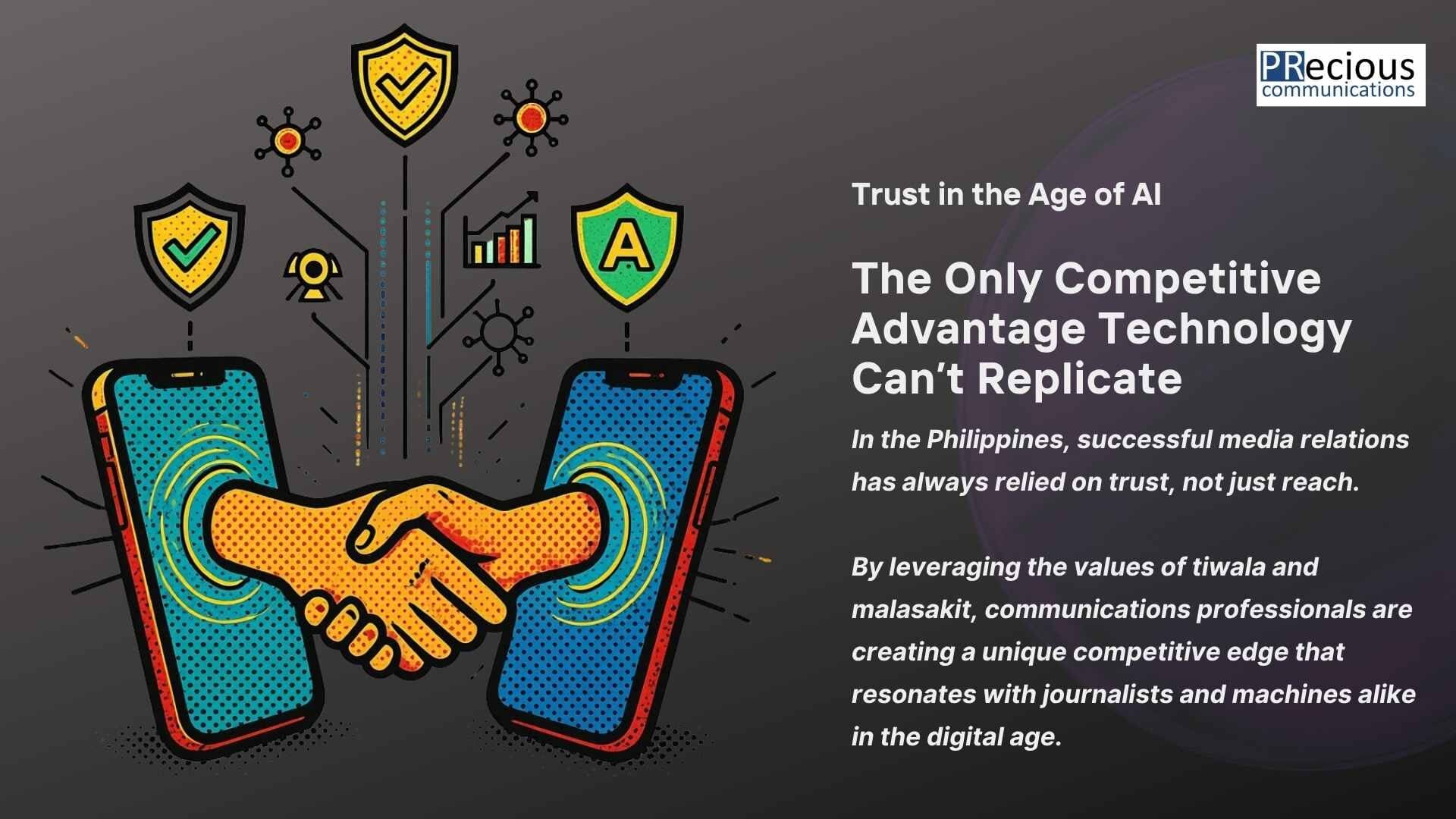
- The Human Premium: Authenticity and cultural values—like tiwala (trust) and malasakit (care)—drive real-world influence in ways that automation cannot replicate.
- Mastering GEO: PR strategy must evolve to influence both human readers and the AI ecosystems (“Generative Engine Optimization”) that inform buyer decisions.
- Shift from Volume to Authority: Stop competing on content output. Instead, focus on building a consistent, verifiable “body of evidence” that AI models and decision-makers recognize as authoritative.
The Economics of Communications: Reclaiming the Human Premium
This technological shift is fundamentally changing the economics of corporate communications. Execution is becoming easier to replicate. Strategy remains essential, but strategy alone is no longer enough when competitors have access to the same technology and similar insights. What becomes increasingly difficult to replicate are the relationships, credibility, and professional judgment developed over years of consistent engagement. Technology is no longer the barrier to entry; trust is.
For years, organizations invested heavily in producing more content, distributing more information, and expanding their communications channels. Artificial intelligence makes those activities significantly faster and more efficient. What it does not do is persuade people to believe what they read. Credibility is earned through consistency. Reputation is built through experience. Confidence develops over time. These qualities cannot be generated with a prompt.
As AI becomes embedded in everyday communications, the organizations that consistently stand apart will not necessarily be those producing the most content. They will be those whose stakeholders already recognize them as credible, reliable, and trustworthy sources of information. This reality is particularly visible in media relations.
The Sighting of Trust: A Tale of Two Pitches
The challenge facing modern journalists has never been a lack of information. It is a lack of information they can safely trust. To understand how the human relationship premium operates in an automated world, consider a simple B2B scenario:
A Direct Contrast in B2B Outreach
Imagine two organizations announcing similar product launches in Southeast Asia:
• Organization A uses artificial intelligence to write its press release, personalizes its media outreach using automated AI tools, generates a highly professional media kit, and identifies relevant journalists through sophisticated databases and monitoring tools.
• Organization B deploys the exact same automated suite. On paper, both organizations appear equally prepared. Yet, Organization A earns thoughtful coverage, interview requests, and follow-up conversations, while Organization B receives little response.
The difference rarely comes down to technology. It comes down to whether journalists recognize the sender, trust the information being shared, and believe engaging with that organization is worth their limited time. Technology helps secure a place in an inbox, but trust determines what happens after the email is opened.
Organizations with established credibility are better positioned during product launches, corporate announcements, public issues, and moments of crisis. Strong relationships with journalists create faster access to trusted sources, encourage more balanced conversations, and reinforce confidence among customers, investors, regulators, employees, and other stakeholders. In an environment where information travels instantly and AI is making content easier to produce, credibility is no longer simply a communications objective—it is a core business advantage.
The Philippine Context: Cultural Anchors of Trust
For communications professionals in the Philippines, this principle is far from new. Long before artificial intelligence entered the boardroom conversation, successful media relations had always depended on the quality of relationships rather than the quantity of outreach. Building those relationships has never been about maintaining the largest media database or sending the highest number of pitches. It has always been about earning trust through consistent, honorable actions.
In Filipino culture, two fundamental values help explain why those relationships endure:
1. Tiwala (Confidence and Reliability): The confidence that develops through reliability and consistency. It is earned over time by honoring commitments, providing accurate information, respecting editorial independence, and remaining dependable long after a single campaign has concluded.
2. Malasakit (Shared Responsibility and Care): While often translated as compassion or genuine care, its meaning in professional practice extends much further. In strategic communications, malasakit is reflected in deeply understanding a journalist’s needs, respecting strict deadlines, preparing spokespeople thoroughly, responding honestly during difficult conversations, and recognizing that strong professional relationships are built through mutual respect rather than transactional exchanges.
These values rarely appear in campaign reports, and they cannot be quantified on traditional measurement dashboards. Yet, they shape the outcome of every campaign that follows. Journalists remember who helped them meet a deadline. They remember who provided reliable information when facts were still emerging. They remember who remained transparent when the answers were difficult. Those moments build professional reputations that extend well beyond a single news cycle. Artificial intelligence changes how we communicate; it does not change why people choose to trust.
In many ways, the widespread adoption of AI is making these human qualities even more valuable. As automated content becomes increasingly common, authenticity, credibility, and genuine relationships become easier to recognize and significantly harder to imitate. The future of communications will not belong to those who produce the most content; it will belong to those whose credibility has already been earned.
SXO & GEO: Making Human Credibility Machine-Readable
That earned human credibility is becoming valuable for another strategic reason: it is no longer influencing only people. Increasingly, it is influencing the artificial intelligence systems that B2B decision-makers, buyers, and partners rely on every single day to gather intelligence.
For decades, the value of public relations was measured strictly by its influence on human perception. Communications professionals built relationships with journalists, earned third-party validation, and shaped public opinion through credible storytelling. Those outcomes remain as important as ever, but artificial intelligence is expanding their impact in ways many organizations are only beginning to recognize. The conversation around AI often positions people and machines as opposing forces. The reality is far more integrated.
Large Language Models (LLMs) such as ChatGPT, Gemini, Claude, and Perplexity do not independently decide which organizations deserve recognition. They learn from the information ecosystem surrounding them. They identify patterns across trusted publications, expert commentary, academic research, official sources, and consistent third-party validation. The more credible and consistent those signals become, the more confidently AI systems reference and recommend them when answering queries.
This is where public relations increasingly intersects with Generative Engine Optimization, or GEO. Unlike traditional search engine optimization (SEO), which focuses on improving rankings and driving clicks to your own domain, GEO focuses on strengthening an organization’s presence and accuracy within the synthesized, AI-generated answers. Sourcing patterns behave differently based on model architecture:
• Claude (Anthropic): Favors highly authoritative, institutional, and research-led English domains, possessing high cross-language stability.
• GPT-5.1 (OpenAI): Swaps its entire site ecosystem based on query language. Winning Bahasa or Tagalog queries requires dedicated, local-language earned coverage.
• Perplexity: Prioritizes real-time, diverse domain sourcing, heavily indexing video transcripts, structured product listings, and real-time feeds.
• Gemini (Google): Highly brand-friendly, citing official corporate domains in up to 50% of its mix, provided they feature structured, comparative schemas.
When an enterprise buyer asks an AI assistant which vendor leads in a specific technology segment, the response is informed by a broad body of credible information accumulated over time. Every executive interview, every thought leadership article, every piece of earned media, and every expert commentary strengthens the body of evidence that helps establish an organization’s Entity Authority within both traditional media and AI-powered discovery.
Human credibility is becoming machine-readable. This does not mean communications strategies should be designed solely for artificial intelligence. Trust cannot be manufactured for algorithms, nor should it be. The same principles that build credibility with journalists also strengthen credibility with AI systems: Accuracy, Transparency, Consistency, Expertise, and Independent validation.
Artificial intelligence is not replacing the importance of public relations; it is reinforcing why trusted, consistent communications matter even more. The strongest relationships are built long before the first press release is written.
Align Your Narrative for the Intelligence Economy
Is your brand invisible to the search algorithms and the decision-makers that rely on them?
Contact the award-winning PRecious Communications Philippines team today to schedule a consultation and request your custom PRecious Pulse Brand Audit. Let us help you map your invisible consideration loop.
About the Author
John Caparros is the Media and Community Partnerships Lead at PRecious Communications Philippines. With deep roots in the Philippine media landscape, John specializes in developing high-value, relational communications strategies that translate cultural values of tiwala and malasakit into bulletproof brand equity. His work bridges traditional media relations with digital-first influence architecture to future-proof corporate reputations in the age of AI.