Editor’s Note: A version of this article was originally written by Lars Voedisch, Founder & Group CEO of PRecious Communications, and published on the Forbes Agency Council on July 28, 2026. We are republishing it here on the PRecious Communications Insights platform to share these essential thoughts on strategic AI adoption and trust with our audience.
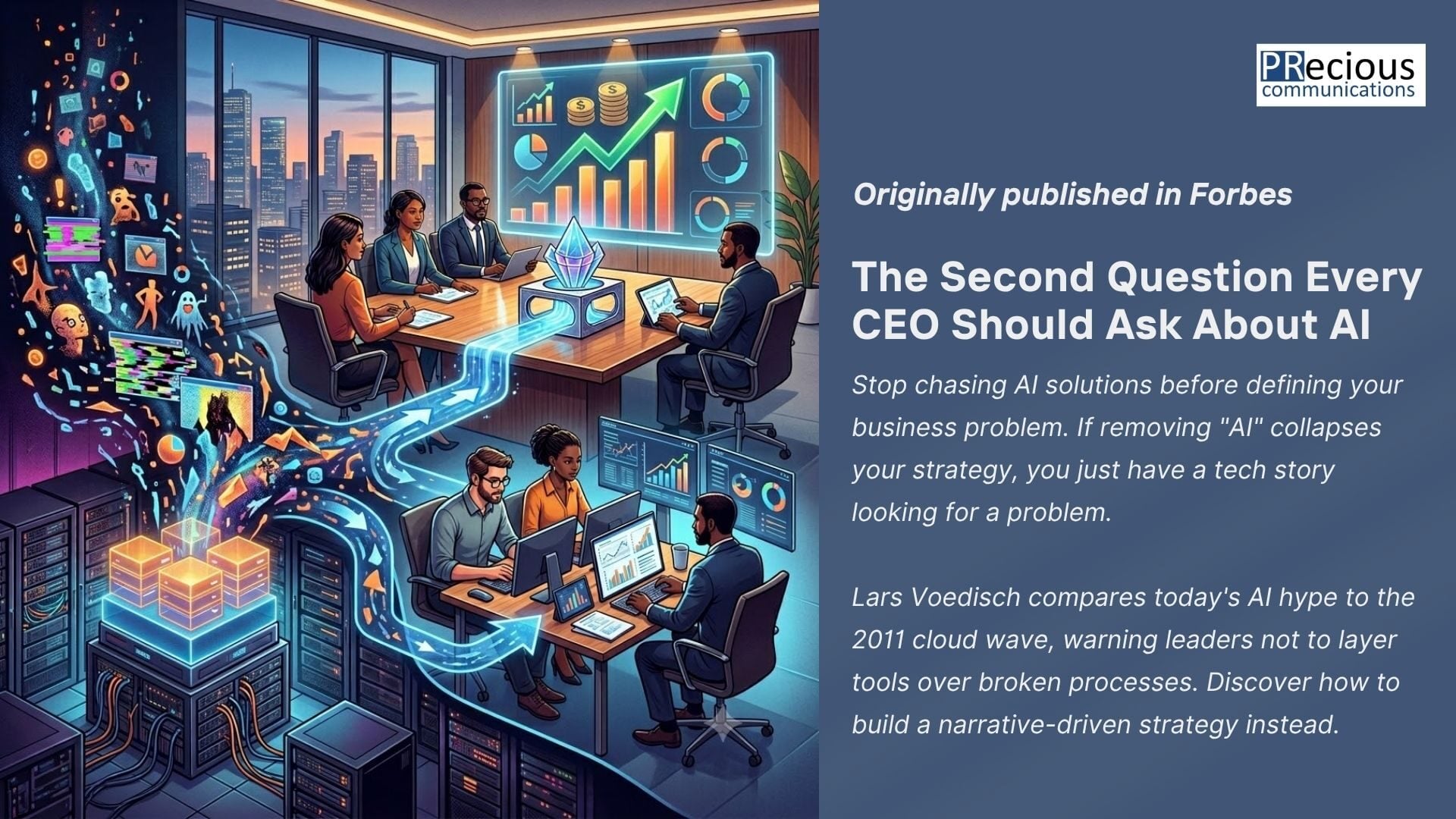
Organizations across Southeast Asia are increasingly falling in love with AI solutions before identifying the business problems they are intended to solve. Lars Voedisch, Founder & CEO of PRecious Communications, intervenes in this technical noise to pressure-test the intersection of technology, leadership, and regional trust. Drawing on structural lessons from the 2011 cloud wave, Lars argues that the primary hurdle for the C-suite is no longer technical—it is the strategic necessity of moving communications upstream to navigate a fragmented, “Glocal” market.
Strategic Summary: Key Takeaways for Leaders
- Identify the Business Problem First: AI success fails when organizations rush into technical solutions before aligning on the specific, real-world business issue they need to solve.
- The Ultimate Test is Trust: Technology transformation is not just a systems challenge; it is a leadership challenge that hinges on bridging the strategic trust gap with employees, customers, investors, and regulators.
- Bring Communications Upstream: Strategic communicators must be brought in before AI narratives are finalized to pressure-test strategy, align leadership, and prevent internal confusion from turning into external noise.
- The AI Litmus Test: If removing the buzzword “AI” from your plan causes the entire business case to collapse, you have a technology story looking for a problem, not a robust AI strategy.
From Hypervisors to Hallucinations: The 2011 Analogy
The current rush toward AI transformation marks a systemic shift from technical engineering to business growth, mirroring the cloud virtualization wave of 2011. During that era, the “noisy middle” of the market was obsessed with technical jargon—hypervisors, virtualization layers, and server utilization.
This mirrored today’s obsession with LLMs and RAG.However, the structural similarity lies in the evolution of C-suite resistance. Just as cloud adoption moved from a “server room” concern regarding data loss to a boardroom priority for agility and scale, AI is currently transitioning from a technical novelty to a strategic mandate. The primary hurdle remains the same: translating technical possibility into business strategy. Successful leaders in 2011 didn’t ask how virtualization worked; they asked how it enabled the business to pivot. Today’s CEOs must apply that same discipline.
The Real Test Is Trust
In fragmented markets where the “SEA Comms Split” is a reality, AI transformation is rarely a technology problem; it is a leadership and trust problem.
Identifying the business problem is the first step, but the strategy faces its ultimate test with the Second Question : How do we bring everyone whose trust determines our success with us?For a strategy to scale, leaders must secure the confidence of employees, customers, and investors.
When a gap exists between technical capability and stakeholder confidence, it is a strategic failure of narrative alignment. In Southeast Asia’s digital economy, where regulatory environments like Indonesia’s “T3” AI framework are standardizing governance, trust has become a tangible commercial asset.
Evidence-Based Insights: The Data of Disruption
Data confirms that communications and narrative alignment must move “upstream” to prevent transformation failure:
- Microsoft’s 2026 Work Trend Index: Identifies a “transformation paradox” where employee readiness outpaces organizational agility. This highlights the urgent need for Executive Communication and Leadership Branding to align internal culture with tech capability.
- MIT Sloan School of Management: Argues that AI value is created only when work is redesigned around problems. Without a clear narrative, organizations simply “layer tools over broken processes,” leading directly to the “AI content fatigue” now observed in the Philippine and broader ASEAN markets.
- McKinsey Research: Finds that successful transformations are linked to CEOs who communicate a compelling “change story.” This proves that Trust is a measurable KPI of success. Without it, the Public Relations and Reputation Management of the firm becomes a liability rather than an advantage.
The Glocal Mandate: Moving Comms Upstream
Historically, communications was the “final mile”—the packaging of a hardened strategy.
In the AI era, this sequence is a commercial risk. Strategic advisors must be in the room to pressure-test the narrative before it hardens into external noise. By leveraging Generative Engine Optimization (GEO) insights, leaders can ensure their brand is discoverable by the AI models that 94% of B2B buyers now use to start their procurement journeys.
In Vietnam’s “media crunch” or Indonesia’s “T3” era, “spray and pray” visibility is dead; intentional, auditable boardroom narratives are the only way forward.
Before approving your next AI investment, run this mandatory boardroom check:
1. THE PROBLEM AUDIT Are we clear about the specific business problem, or are we selling ourselves a technical solution?
2. NARRATIVE ALIGNMENT Can every leader explain the problem and the business value in the exact same way without jargon?
3. STAKEHOLDER TRUST Will our employees, customers, investors, and regulators understand why we are making this change from their perspective?
The AI Strategy Litmus Test: If you removed the word “AI” from your strategy tomorrow, would the business case still stand? If the answer is no, you do not have an AI strategy—you have a technology story looking for a problem.
Ready to Align Your Business Strategy with Your Brand Narrative?
At PRecious Communications, we have spent over a decade helping enterprise brands, local startups, and regional leaders navigate boardroom transitions and fragmented digital landscapes across Southeast Asia.
Whether you are seeking to pressure-test your corporate narrative, prepare your leaders for transformation, or build resilient relationships, our integrated capabilities are built to deliver:
- Elevate Your Executive Voice: Define your stance on technology and business strategy with our Executive Communication & Leadership Branding and LinkedIn Profiling solutions.
- Navigate Complex Reputations: Guard your brand’s integrity and manage stakeholder expectations with our regional Public Relations and Reputation Management strategies.
- Command Your Information Ecosystem: Optimize how both humans and AI search models discover your business through localized Content Creation and Search Engine Optimisation (SEO) campaigns.
- Scale seamlessly across ASEAN: Utilize our deep localization and regional operational frameworks across our offices in Singapore, Indonesia, Malaysia, the Philippines, Vietnam, and Thailand.
Connect with the PRecious Communications team today to start shaping a trust-first narrative for your organization’s digital future.
A version of this article was originally published on Forbes by Lars Voedisch, Founder & Group CEO at PRecious Communications.
The “Second Question” is: “How do we bring everyone whose trust determines our success with us?” While the first question identifies the business problem, the second addresses the human and leadership architecture required for technology adoption to actually scale.
Trust is the primary KPI of AI success. Transformation stalls when stakeholders do not see leaders modeling behavioral changes or when the “Glocal Mandate” for transparency is ignored, particularly in complex markets like Indonesia and the Philippines.
The transformation paradox occurs when employee readiness for AI outpaces organizational agility. Fundamentally, this is a communications failure where old metrics and weak leadership alignment prevent technical possibility from becoming business value.