As global communicators gather to celebrate World PR Day on July 16, 2026, the business landscape across Southeast Asia (SEA) is experiencing a pivot. Previously, corporate expansion in the region followed a simple formula: distribute high-volume press releases and measure success by clipping counts.
The Strategic Summary
- The Boardroom Shift: Corporate communications has transitioned from a downstream tactical execution task to a core balance-sheet asset—occupying the “Fifth Seat” at the boardroom table alongside the Chairman, CEO, CFO, and CMO.
- Algorithmic Discovery: Traditional SEO is being replaced by Generative Engine Optimization (GEO). With 94% of B2B procurement journeys initiating on conversational AI platforms, brands must build structured digital trust trails to ensure they are cited.
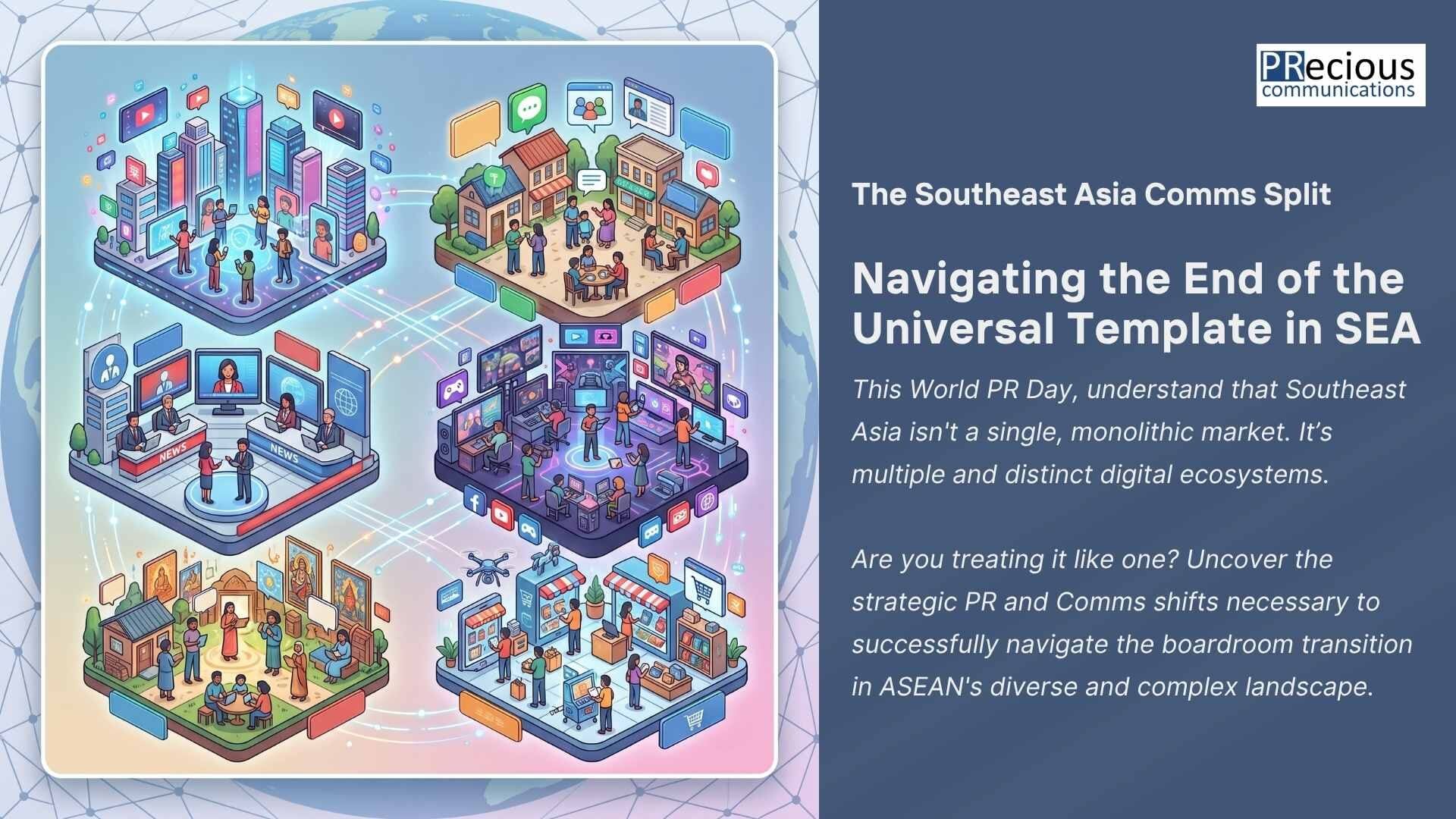
- Hyperlocal Fragmentation: Southeast Asia is not a single, uniform information environment but six distinct digital ecosystems. Success requires replacing one-size-fits-all global templates with localized “glocal” governance.
The Fragmented Digital Frontier of 2026
In today’s Intelligence Economy, that legacy “spray and pray” model is not merely obsolete; it is a direct commercial and reputational risk. Southeast Asia is not a single, monolithic market. It is a highly fragmented digital frontier characterized by tightening statutory regulations, localized media trust patterns, and the rise of algorithmic search.
As Lars Voedisch, Founder and Group CEO of PRecious Communications, recently observed:
“Southeast Asia is not a single information environment. It is multiple distinct digital ecosystems, each shaped by its own language hierarchies, media trust patterns and platform behaviors. A brand with strong visibility in English-language AI responses may be essentially absent from what those same systems surface in Indonesian, Thai, Vietnamese or Tagalog.”
To survive this transition, organizations must move beyond the “Control Illusion” of central management and embrace Navigational Intelligence—the specialized capability to guide a brand through high-stakes IPOs, mergers and acquisitions, complex litigation, and volatile regional regulatory shifts.
Part 1: The Three Similarities (The Shared ASEAN Baseline)
Despite localized differences, three strategic similarities unify the Southeast Asian communications landscape in 2026, forming the structural foundation of modern reputation management.
1. The “Fifth Seat” Boardroom Mandate
The CCO has transitioned into the boardroom. Corporate communications is no longer a downstream tactical function brought in to “manage the media” after decisions are finalized. Today, communications leaders sit in the “Fifth Seat” alongside the Chairman, CEO, CFO, and CMO. Because a single misstep or viral video can trigger regulatory scrutiny or public backlash within hours, reputation must be governed proactively as a balance-sheet asset.
2. The SXO and GEO Frontier
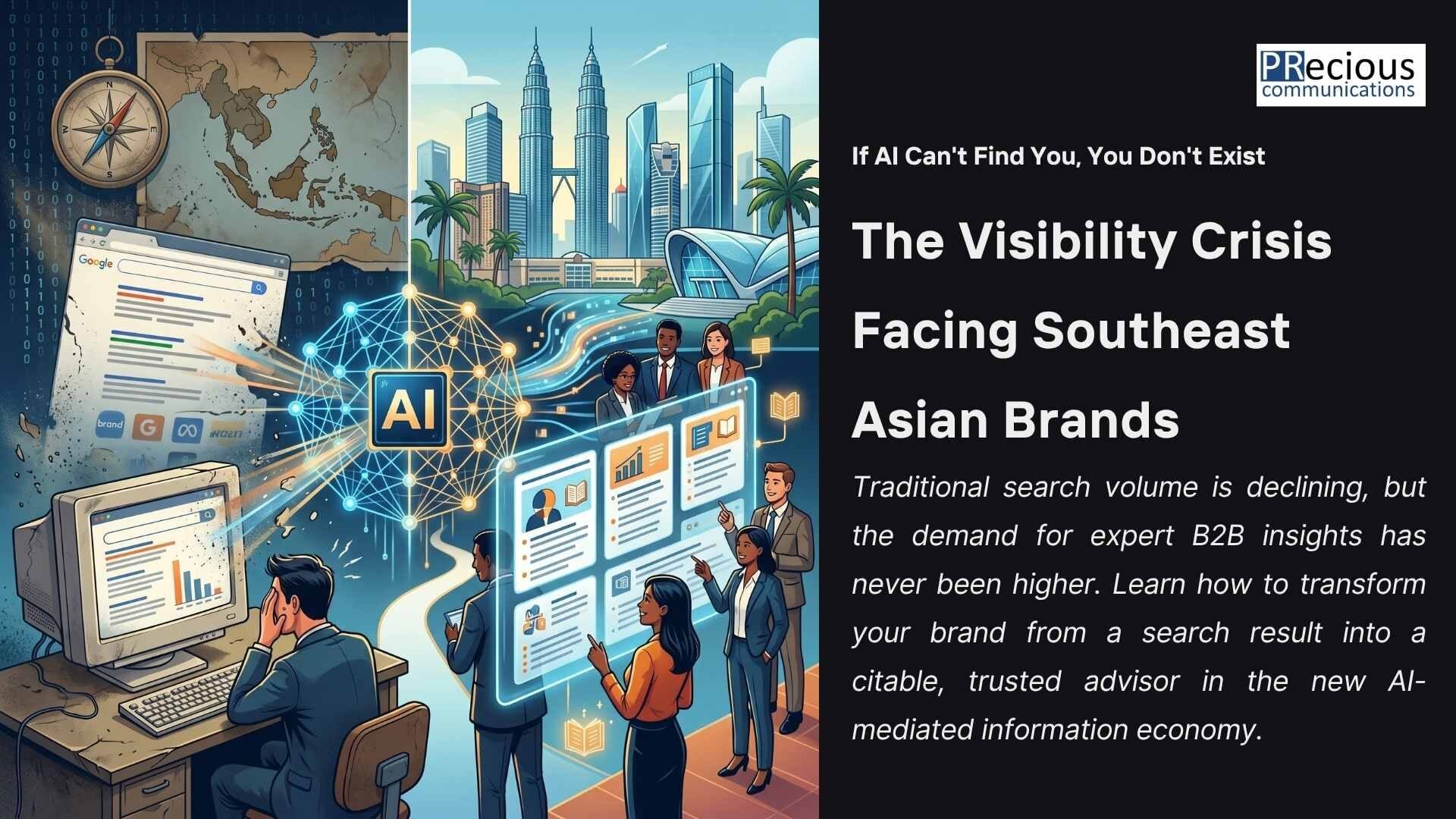
Digital discoverability has moved beyond traditional SEO. B2B buyers no longer browse multiple pages of search results; they query Large Language Models (LLMs) like ChatGPT, Google Gemini, and Perplexity for vendor shortlists. This shift demands Generative Engine Optimization (GEO) and Search Experience Optimization (SXO). Under the PRecious Communications GEO framework, brands must build structured, machine-readable digital footprints—using JSON-LD Schema (Organization, Service, FAQ, and Author) and an llms.txt file—to ensure AI crawlers can easily extract and cite their corporate assets.
3. Shifting from Clip Counts to the Stakeholder-Outcome Engine
CMOs and CFOs are rejecting the “show ponies” of vanity metrics. Impression counts and Advertising Value Equivalency (AVE) are useless for proving business value. To protect budgets, public relations must operate as a Stakeholder-Outcome Engine. This proprietary PRecious Communications framework measures success strictly through auditable business results: qualified lead generation, message pull-through, and direct pipeline contribution, shifting the focus from how loud a brand is to the actual behavior change it creates.
Part 2: The Three Stark Differences (The Hyperlocal Realities)
While shared baseline trends exist, executing a centralized, top-down strategy across ASEAN’s diverse geographies is a guarantee of failure. Winning requires a deeply localized approach that respects the unique regulatory, cultural, and operational realities of each country.
1. Vietnam (Strict Statutory Compliance) vs. The Philippines (Reputation Resilience)
Vietnam and the Philippines require entirely different operational frameworks.
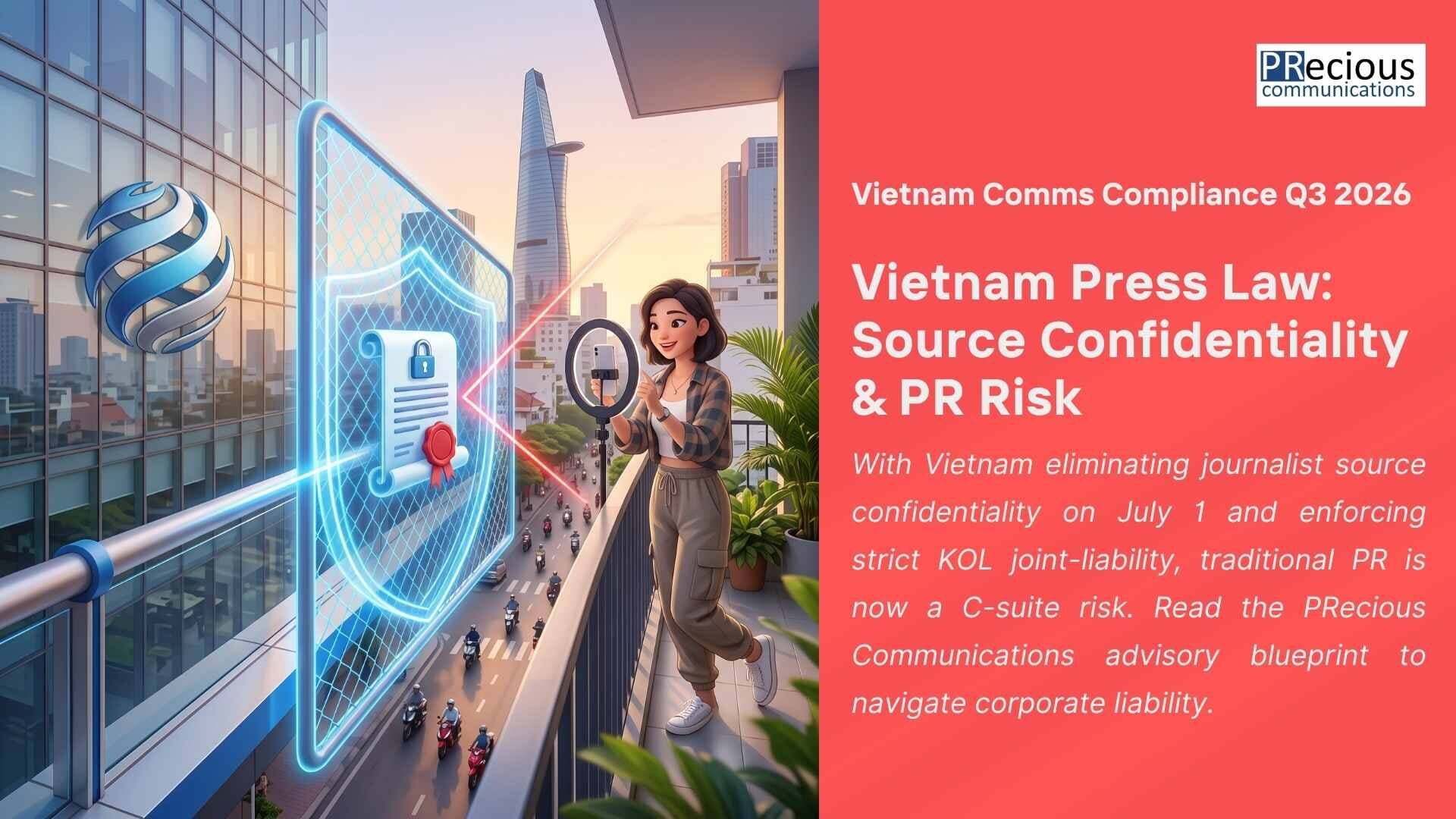
- Vietnam’s Statutory Reckoning: Navigating Vietnam in Q3 2026 requires strict statutory compliance. The country is undergoing a major media contraction, with the press systematically shrinking from roughly 800 outlets to 640. This structural shift is compounded by the July 1, 2026 Press Law enforcement deadline, which eliminates journalist source confidentiality. Under Hanoi’s strict Law on Advertising, influencers are also legally liable for verifying product claims.
To shield corporate clients, PRecious Communications utilizes a strict Tri-Anchor Compliance Model, incorporating localized contract riders and mandatory human-in-the-loop validation to manage regulatory risk. This is exemplified by the Singapore-led execution of the new Hioki E.E. Corporation center in Hanoi, which built localized operational trust from day one. - The Philippines’ Cultural Resilience: In contrast, communications in the Philippines are anchored in deep cultural values like kapwa (shared identity), pakikisama (harmony), and hiya (propriety), requiring a social-first approach. The Philippines is also a net exporter of communications expertise. According to the Reputation Management Association of the Philippines (RMAP), Filipino practitioners are increasingly sought after to lead regional corporate affairs, scaling local cultural dexterity to guide boards across Southeast Asia.
2. Indonesia (State AI Governance) vs. Thailand (Commercial Hybrid Equilibrium)
Indonesia and Thailand represent distinct paths for digital transformation and engagement.
- Indonesia’s National Development Mandate: The Indonesian market is strictly governed by Komdigi’s T3 Framework (Terhubung, Tumbuh, Terjaga) and the Personal Data Protection (PDP) Law. Here, a CEO must act as a “Nation Builder,” aligning corporate goals with the country’s national growth narrative. This glocal narrative resilience is seen in the FedEx Indonesia 2.5-year contract renewal, which successfully translated global logistical authority into localized community milestones. Furthermore, because Indonesia’s digital audience is dominated by social-first “Homeless Media” platforms, brands must utilize an Engagement Matrix to separate editorial, paid, and community-led interactions.
- Thailand’s Commercial Hybrid Equilibrium: Thailand has bypassed rigid state governance to reach a commercial hybrid equilibrium. In Bangkok, PR agencies function as Digital Asset Studios, integrating narrative storytelling directly with LINE and TikTok Shop. This hybrid strategy merges corporate reputation management with social commerce. Additionally, Thailand’s digital economy is uniquely shaped by “Mutelu”—a digitized, belief-based economy where spiritual alignment is fused with commercial branding. Understanding these nuances, alongside the tokenisation of local carbon credits, is essential for securing brand credibility in the Kingdom.
3. Malaysia (Private “Dark Social” Migration) vs. Singapore (Data Intelligence Control Tower)
The flow of information divides these neighboring hubs into two distinct regional roles.
- Malaysia’s Dark Social Shift: In Malaysia, public trust challenges have driven B2B communications behind closed doors to private “Dark Social” channels like WhatsApp and Discord. Under tightening MCMC class licensing and LHDN influencer tax guidelines, the “3Rs” (Race, Religion, and Royalty) are critical legal liabilities. To bypass the “Awareness Trap,” brands must earn space in private networks through localized “Cultural Insiders.”
“When public trust is highly sensitive, global templates fail. We must deploy cultural insiders who understand regional subcultures and can clinically navigate local sensitivities.” - Singapore’s Regional Control Tower: Singapore operates as the region’s trusted “Control Tower of Data Intelligence,” focusing on sovereign AI clouds, Tier-4 green data centers, and robust data sovereignty rather than private dark social channels. The Singapore narrative focuses on Trusted Connectivity and corporate governance, positioning the city-state as the stable, secure anchor that coordinates cross-border regional campaigns.
Earning the License to Lead
This World PR Day serves as an urgent boardroom warning: Southeast Asia’s fragmented digital frontier cannot be managed with legacy templates. Continuing to rely on outdated, high-volume transactional PR is no longer just ineffective—it exposes your brand to legal liability, algorithmic erasure, and severe reputational damage.
At PRecious Communications, we believe that digital trust is established through unscripted human expertise and clinical data anchoring. To build a resilient brand in the Intelligence Economy, you must align your corporate narrative with localized regulations and cultural realities. You must move from a posture of passive media relations to active, compliance-driven operational control.
Don’t leave your regional market valuation to algorithmic chance.
Are you ready to stress-test your regional communications strategy? Contact PRecious Communications today to schedule a comprehensive communications compliance audit, deploy our certified localized frameworks, and secure your brand’s operational license to lead across Southeast Asia.
Frequently Asked Questions: Navigating the 2026 Intelligence Economy
1. What is “Shadow AI” in corporate communications, and how does it threaten brand reputation?
- Shadow AI refers to the unsanctioned use of public artificial intelligence tools by internal teams to draft corporate materials, build graphics, or analyze sensitive data. When employees paste unvetted data into open, consumer-grade AI models, they risk feeding confidential corporate information and trade secrets directly into public neural networks. This introduces severe data sovereignty and compliance risks.
- To prevent this risk, organizations must establish secure, closed-loop AI environments. Under a strict “Govern First” operational model, teams can leverage the efficiency of technology without exposing corporate assets.
- The PRecious Advantage: At PRecious Communications, we have completely eliminated Shadow AI risks by migrating our regional practices to a secure, enterprise-grade technology stack (including Google Gemini, Gimmefy, and Zoom AI), ensuring 100% data security and compliance for our clients.
2. How does Search Experience Optimization (SXO) differ from traditional SEO for B2B brands?
- Traditional Search Engine Optimization (SEO) focuses on driving user clicks to a website from a page of search engine results. However, search behaviors are changing, with conversational AI platforms rapidly replacing standard search queries.
- Search Experience Optimization (SXO) and Generative Engine Optimization (GEO) optimize your brand’s digital footprint so that Large Language Models (LLMs) synthesize and cite your brand as the definitive answer to user queries. Winning this “Share of Model” requires a technical backend structured for machines, using advanced JSON-LD Schema (such as Organization, Service, FAQ, and Author Schema) alongside an llms.txt file to guide AI crawlers.
- The PRecious Advantage: We help clients transition from simple keyword optimization to building high-density “SXO Narrative Moats,” ensuring your enterprise is the cited, trusted recommendation when B2B buyers query AI platforms.
3. How can corporate communications help marketing teams collect “Zero-Party Data”?
- As traditional third-party data tracking and browser cookies are phased out, brands are struggling to track buyer intent. Corporate communications can solve this problem by generating Zero-Party Data (information that consumers intentionally and proactively share with a brand).
- Instead of pushing one-way corporate press releases, communications teams can design interactive narrative platforms, community-driven product trials, and gamified reporting. This shifts public relations from a pure brand awareness expense into a direct, measurable contributor to the sales pipeline.
- The PRecious Advantage: Through our specialized SPARKS (Tech & Startups) and LIFE (Consumer) practices, we design high-value “Value Exchanges” that allow brands to build organic community trust while capturing actionable buyer intent.
4. Why are Southeast Asian brands shifting from major celebrity endorsements to “Renting Affinity”?
- Audiences are suffering from severe advertising fatigue, and highly scripted, transactional celebrity endorsements are losing their credibility. Modern consumer trust has migrated away from massive scale toward smaller, tight-knit digital communities and private spaces.
- Shifting your budget to “Renting Affinity” means partnering with relatable, mid-tier practitioners and nano-influencers (ranging from 1,000 to 5,000 followers) who generate an exceptional 4.79% engagement rate. Young buyers trust these creators because their relationships are built on genuine peer-to-peer validation rather than transactional sponsorship.
- The PRecious Advantage: We actively manage a regional network of vetted “Cultural Insiders” across Southeast Asia, allowing global brands to bypass traditional advertising blocks and build authentic relevance within localized communities.
5. What is the “Validation Paradox” in B2B tech procurement, and how do we bridge it?
- The Validation Paradox describes a tension in modern B2B purchasing: while 94% of business buyers utilize automated AI engines to research and shortlist vendors, they still require multiple human interactions to close high-stakes, high-value corporate deals. In fact, enterprise software and advisory contracts often require an average of 16 human interactions before a final purchase is completed.
- Winning the initial AI shortlist gets your brand in the room, but converting that lead requires structured, offline social proof, targeted executive thought leadership, and clinical evidence maps.
- The PRecious Advantage: We bridge this gap by designing comprehensive sales enablement campaigns, including gated credential vaults, interactive case study frameworks, and tailored executive visibility programs that turn digital citations into closed boardroom retainers.
6. Why does the recency of web content affect a brand’s visibility in AI search results?
- Unlike traditional search engines that crawl and index websites periodically, Large Language Models and AI answer engines exhibit a documented recency bias. To ensure answers remain current, search algorithms prioritize a “30-Day Freshness Mandate”.
- Data indicates that high-value content published or updated within a 30-day window receives a 3.2x multiplier in citation frequency. If your brand experiences a quiet month in media visibility or lets its owned content remain dormant, AI models will rapidly de-index your brand, ceding your cited authority to more active competitors.
- The PRecious Advantage: We protect our clients from visibility decay by deploying our proprietary 4A Model to manage an “Always-On” content engine, ensuring your corporate proof points are consistently updated and recognized by AI crawlers year-round.
Contact PRecious Communications today to secure your brand’s operational future in Southeast Asia.