SAMY Nordics and The Network One recently released its 2026 Social-First Trends, and independent agencies from around the world weighed in with their perspectives.
PRecious Communications is honoured to be part of that collective conversation. While these insights are rooted in social trends, many of the takeaways extend to modern PR. Especially now that PR has evolved into a deeply digital discipline.
It only takes one viral misstep to put credibility on the line. A single mistake can spread faster than any campaign, and smart PR can make the difference between handling the situation gracefully or watching it spiral online.
Earned visibility now starts on feeds, not front pages. That sentence still feels strange to some veterans in PR, but look around.
- Products don’t “launch” anymore, they quietly sell out after a TikTok mention.
- Creators command more active attention than many prime-time TV slots.
- Audiences scroll, save, share, and decide, all in one sitting.
If brands want relevance and real-world impact in 2026, social-first isn’t optional. So, let’s talk about what is actually shifting.
The Authenticity Paradox
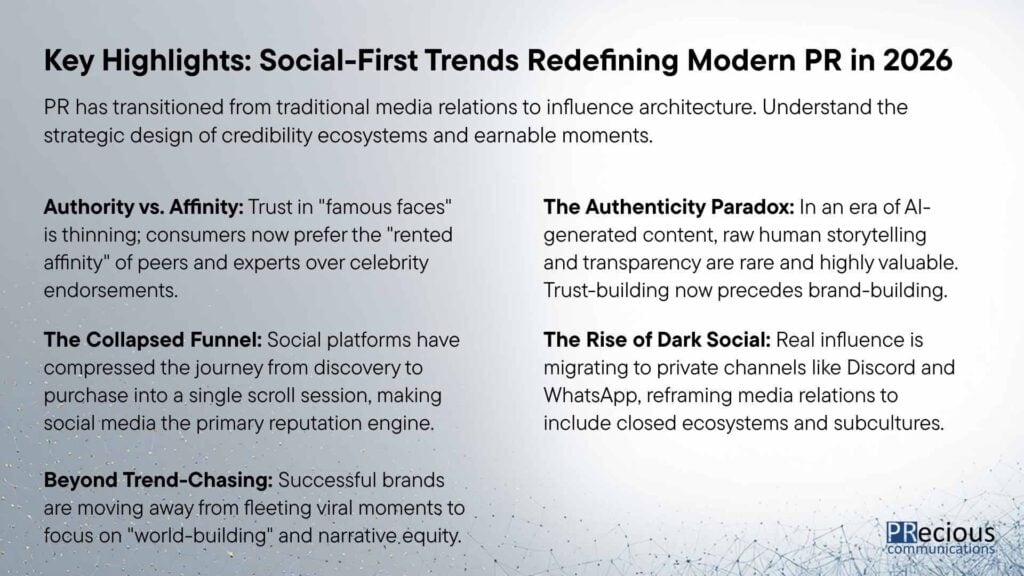
With so much AI-generated content flooding timelines, anyone can whip up a post in minutes. Raw human storytelling suddenly feels rare, and valuable.
It’s surprising because, for years, we believed that churning out more content meant more impact. Turns out, that’s far from reality. Audiences can spot overly polished brand posts from a mile away.
Perfect lighting, perfect captions, perfect… nothing. What actually cuts through now is transparency: behind-the-scenes glimpses, founder POVs, unfiltered employee voices. In PR terms, trust-building matters more than brand-building, at least in terms of sequencing. Raw authenticity is what truly resonates.
Authority vs Affinity
Celebrity endorsements still exist but they don’t carry the same weight. Trust in institutions and “famous faces” is thinning, while peer credibility is thickening.
Consumers lean towards people who feel familiar–industry practitioners, creators with live experience, internal subject matter experts. Renting authority is out. Renting affinity is in. The new creative currency? Verified expertise wrapped in relatability.
The Rise of Dark Social
Mass reach is overrated. Today’s real influence often lives inside Discord servers, Reddit threads, Telegram channels, and private WhatsApp groups. A few hundred deeply engaged community members can drive more action than half a million passive scrollers.
Welcome to dark social, the quiet conversion engine. This reframes media relations entirely because it’s no longer just about journalists. It’s about ecosystems, communities, and subcultures, each with their own codes and rhythms.
How the Funnel Collapsed
The traditional awareness-consideration-conversion funnel has become less useful as a mental model. Social platforms now collapse that journey into seconds. Algorithms surface content that creates desire before users even realise they’re in-market.
Discovery, validation, and purchase happen in the same scroll session. Social isn’t “top of funnel” anymore. It is the funnel.
And it is more than that. It’s your reputation engine, shaping perception, trust, and intent long before a press release–or any official message–ever hits the public eye. For PR pros, that means your work isn’t just about awareness; it’s orchestrating the entire decision-making journey in real time.
Beyond Trend-Chasing
Chasing every viral meme is exhausting, and short-sighted. The brands winning right now aren’t trend-hopping–they’re world-building.
Think recurring content formats. Episodic storytelling. Familiar faces. Consistent narratives. PR’s job shifts from chasing fleeting moments to building narrative equity. It’s a slow burn and a long game, but it builds real loyalty.
A Few More Realities
- Search is changing: Social search is eating into traditional search, especially with younger audiences. Social SEO is now officially a thing. Brands now need to behave like entertainment studios rather than advertisers.
- The power of mid-tier creators: Creators with 10k–200k followers consistently outperform celebrities in engagement.
The opinion economy: Every scroll, tap, and share shapes what people think, feel, and eventually buy, whether we like it or not.
PR is no longer just media relations. It is influence architecture.
Which brings us to this. That means building credibility ecosystems across creators, SMEs, journalists, and niche communities. It means managing always-on reputation, not campaign-based bursts.
It means designing earnable moments–stories engineered to travel, not be forced. And finally, it means turning trends into strategic leverage instead of chasing the next shiny viral object.
The brands winning in 2026 aren’t chasing trends, they’re building narrative equity.
Ready to Build Narrative Equity?
Stop renting authority and start building your own credibility ecosystem. Whether you need to navigate dark social, engage niche communities, or architect influence that lasts, PRecious Communications can help you design the strategy.
If you’re ready to move from reactive PR to influence architecture, let’s map out what that looks like for your brand.
Let’s shape your 2026 narrative. Book a Consultation
Get the complete “Social-First Trends 2026” report from SAMY Alliance for a deeper dive into the data, case studies, and strategies redefining the industry.
Author: Hannah Kiwahko is an Associate Country Lead (Philippines) with 13 years of experience specializing in digital marketing. Over the course of her career, she has led award-winning, performance-driven campaigns across the FMCG, pharma, lifestyle, and tech industries.
Connect with Hannah on LinkedIn
Frequently Asked Questions
Traditional PR often focuses on media relations and managing reputation through official channels. Influence architecture is the strategic design of credibility ecosystems. It recognises that influence no longer flows solely from top-down institutions or celebrities, but through networks of peers, creators, and subject matter experts.
Instead of relying on campaign-based bursts of publicity, influence architecture requires managing an “always-on” reputation where you build narrative equity over time. It involves orchestrating the entire decision-making journey in real-time by engaging with niche communities, creators, and journalists simultaneously.
Dark social refers to private or semi-private channels like Discord servers, WhatsApp groups, and Reddit threads.
While these spaces do not offer the mass reach of a public feed, they solve the issue of “passive scrolling” by hosting deeply engaged communities. In 2026, mass reach is viewed as overrated because real influence requires trust and shared identity, which thrive in these closed ecosystems.
It acts as a “quiet conversion engine” because recommendations made in these private, high-trust environments often drive more concrete action than broad broadcasting to half a million passive viewers.
The traditional linear model of awareness leading to consideration and then conversion has collapsed. On modern social platforms, the entire journey—discovery, validation, and purchase—can happen in a single scroll session.
Social media is no longer just the “top of the funnel” used for awareness; it is the funnel. Algorithms now surface content that creates desire before a user even realises they are in the market for a product, effectively creating intent rather than just waiting for it. For PR professionals, this means content must be designed to answer search intent and validate trust instantly, rather than just generating buzz.
This shift is driven by the erosion of trust in “famous faces” and institutions. Consumers are moving away from “renting authority” (celebrities) to “renting affinity” (people who feel familiar and relatable).
Mid-tier creators, typically those with 10k–200k followers, sit in a “sweet spot” where they have significant reach but still maintain high engagement and perceived authenticity.
Unlike celebrities, whose engagement metrics are often diluted, these creators anchor real conversations within specific subcultures, offering a sense of belonging and “verified expertise” that feels more honest to the audience.
The paradox lies in the fact that as AI tools make it easier to flood feeds with polished, automated content, the value of raw, human storytelling increases.
While AI is becoming a core creative engine for scaling content and personalisation, audiences have developed a “cringe response” to content that feels overly synthetic or perfect.
Trust is now built through transparency—showing behind-the-scenes flaws, unpolished founder perspectives, and “scrappy” footage. Therefore, the smartest use of AI in 2026 is often to let it handle the grunt work or operate undetectably, while ensuring the forward-facing brand voice remains unmistakably human.