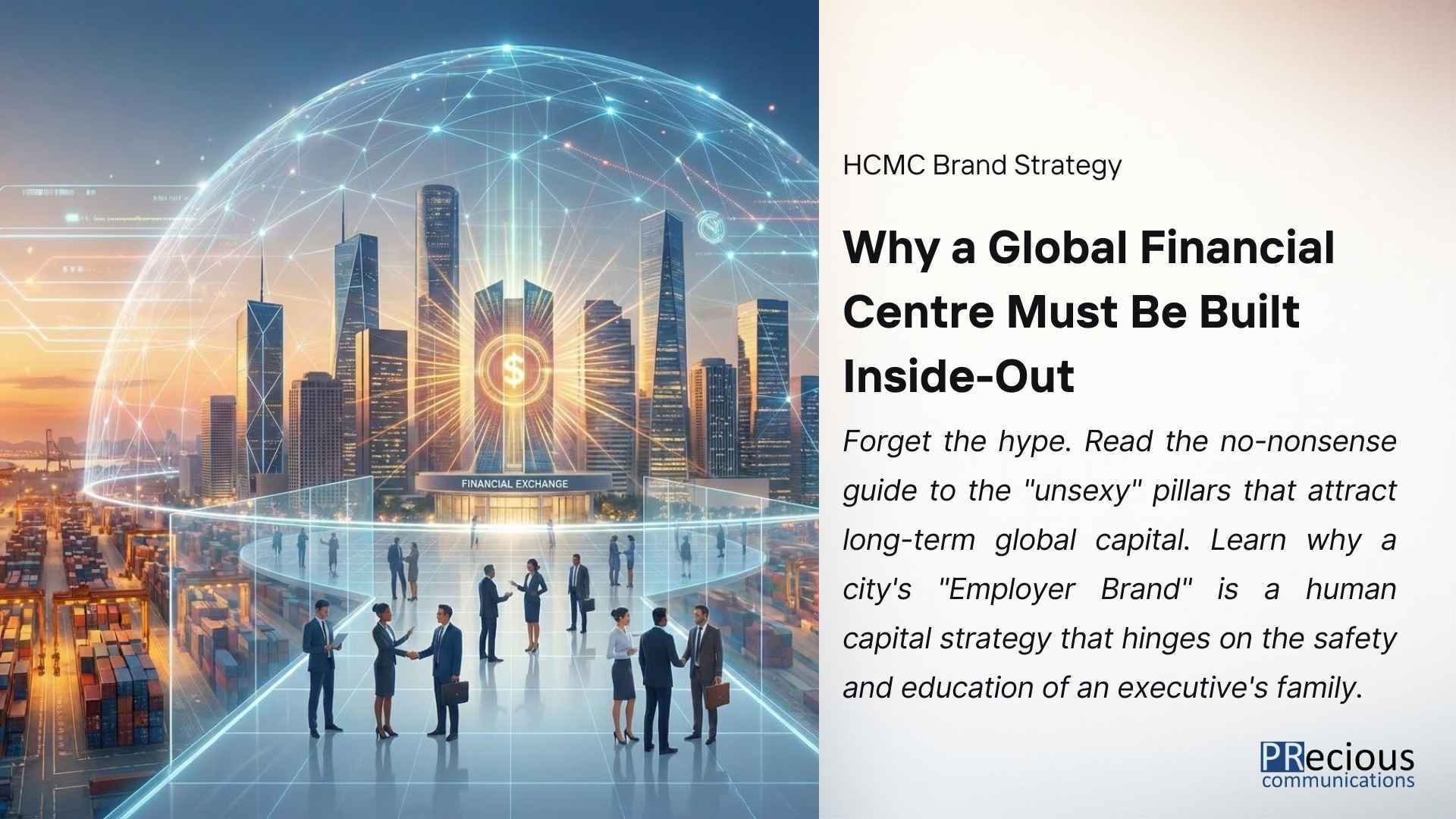
“A city’s brand is built from the inside out.” This was the core message shared by our Group CEO, Lars Voedisch, in his recent feature with Tuổi Trẻ. As Ho Chi Minh City (HCMC) advances its ambition to become an International Financial Centre (IFC), the challenge is no longer just about infrastructure—it is about narrative integrity.
The momentum is undeniable. In late 2025, HCMC climbed three spots to rank 95th in the Global Financial Centres Index (GFCI 38), notably surpassing Bangkok. This trajectory is supported by the city’s Master Plan 2030, which targets an ambitious GRDP growth of 8.5% – 9% and commits a US$7 billion investment into the District 1 and Thu Thiem hubs.
At PRecious Communications, we view this not merely as an urban development project, but as a masterclass in strategic branding. Building on Lars’ insights, we explore how HCMC can translate this economic energy into a sustainable global legacy.
Transparency as the Foundation of Trust
In the global financial arena, “brand” is effectively a synonym for trust. Lars emphasised to Tuổi Trẻ that long-term capital flows towards transparency, enforceability, and neutrality. To compete with established hubs like Singapore—which consistently ranks in the GFCI Top 5—HCMC must prioritise a “no-nonsense” regulatory environment.
Lars notes that “no city becomes a financial hub overnight”. For an investor, a city’s brand strength is defined by its ease of entry. HCMC must demonstrate that the “smooth” (suôn sẻ) business setup Lars described is a reality, backed by digital one-stop centres and clear profit repatriation policies.
The “Employer Brand” of a Metropolis
A city is only as competitive as its human capital. Lars argues that HCMC must develop a “City Employer Brand” that appeals to both the Vietnamese diaspora and international experts. Winning the battle for talent is not just about salaries; it relies heavily on what Lars calls the “Family Factor”.
When a senior executive considers a move, they are not just moving a career; they are moving a household. Factors such as safety, the quality of international education, and overall liveability are decisive. We help organisations articulate their Employer Value Proposition (EVP), and HCMC must do the same to attract the visionary “birds returning to build nests” that Lars described.
The Digital Twin: Branding for the AI Era
This represents a critical shift in modern reputation management. In 2026, a city’s brand does not just live on billboards; it lives in Large Language Models (LLMs). Lars points out that when an investor queries ChatGPT or Google about Vietnam’s financial stability, the AI synthesises a brand identity from the “digital trail” available online.
If the algorithm cannot find accurate, authoritative data, the city effectively does not exist in the digital consciousness. We must ensure that HCMC’s successes—from port modernisation to semiconductor initiatives—are documented with authority in global media. This creates a “Digital Twin” that is as robust and impressive as the city itself.
Residents as the Ultimate Brand Ambassadors
Lars’ “inside-out” philosophy is supported by place-branding theory: residents are the co-producers of a city’s brand. The most powerful endorsements for Ho Chi Minh City come from its own people.
When HCMC’s 9 million citizens feel confident in their city’s transformation into an IFC, they carry that narrative into business meetings and international exchanges. At PRecious, we believe the most effective communications strategies empower internal stakeholders to become external advocates. Whether it is a startup founder in District 1 or a logistics manager in Thu Thiem, their genuine belief is HCMC’s greatest export.
Ready to Tell Your Story Across Southeast Asia?
Navigating the complexities of the ASEAN market requires more than just a presence—it requires a partner who understands the “inside-out” nature of modern reputation.
Whether you are scaling a startup with SPARKS or managing a corporate legacy with INC, PRecious Communications delivers the no-nonsense strategy you need to lead.
Frequently Asked Questions
The shift is driven by Vietnam’s relative political stability and a focused “Action Plan” for the IFC launch. While Bangkok remains a regional hub, HCMC’s aggressive administrative reforms and its role as a “Growth Engine” have signalled higher competitiveness to global investors.
A strong, credible city brand reduces “perceived risk” for investors. When a city is branded as transparent and talent-rich, it attracts lower-cost, long-term institutional capital rather than high-risk, speculative “hot money”.
Historically, the most successful hubs—like London, New York, and Singapore—were ports first. Trade creates the physical movement of value; finance provides the services to manage that movement. HCMC’s logistics corridor is the literal foundation of its financial future.