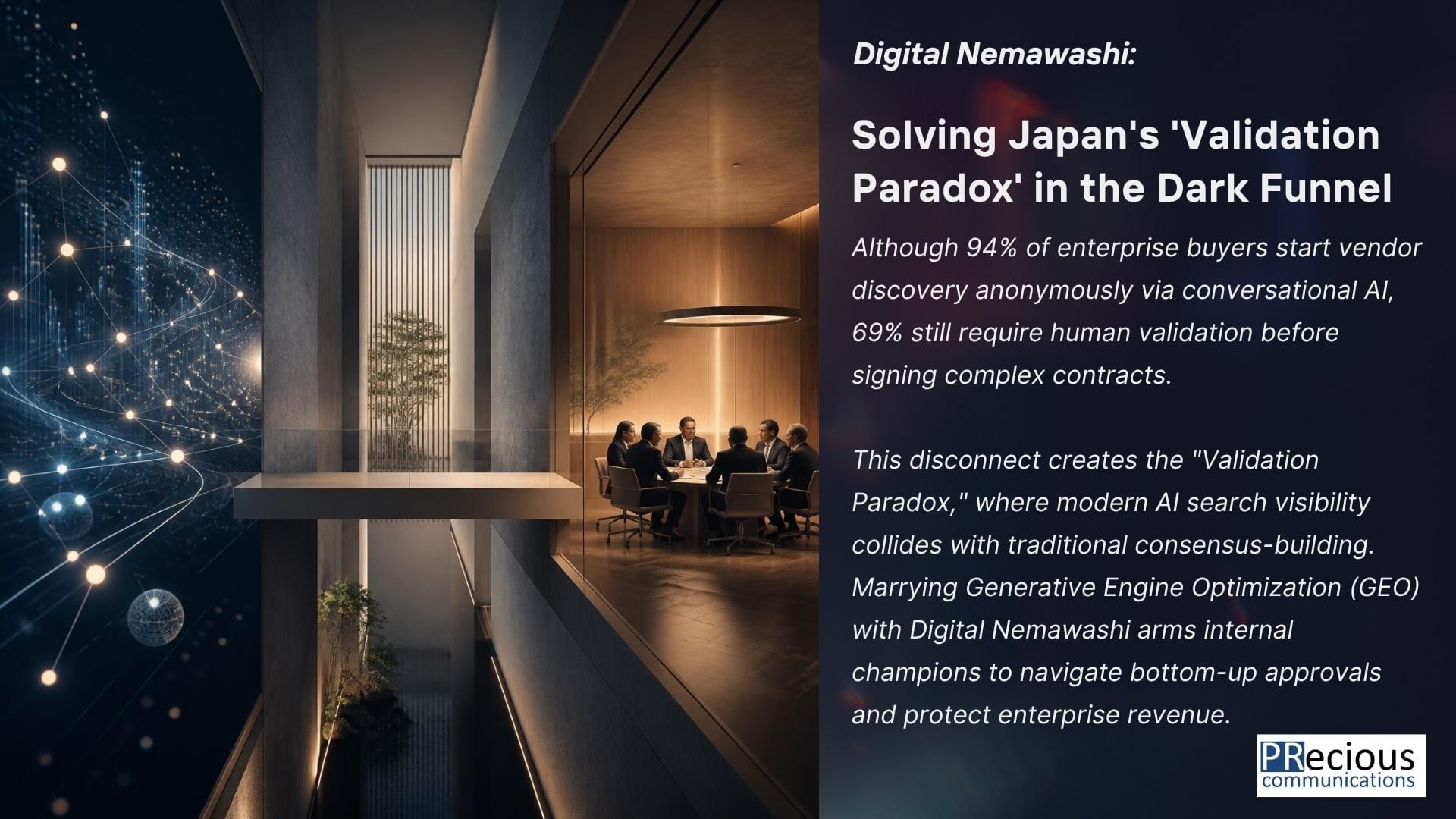
In modern enterprise sales, marketing and revenue leaders are confronting a profound structural crisis: the Validation Paradox. The latest B2B buyer data reveals a stark, contradictory behavior pattern. An overwhelming 94% of buyers now utilize Large Language Models (LLMs) and conversational search engines to conduct anonymous vendor research in the dark funnel. Furthermore, 67% explicitly prefer a completely “rep-free,” self-service digital experience.
Yet, when it comes to finalized, high-ticket purchasing decisions, buyers refuse to trust the machine in isolation. A decisive 69% of B2B buyers report that they still turn to sales representatives to validate the insights generated by AI and to reassure their committees during high-stakes decision points.
This tension represents the Validation Paradox. At PRecious Communications, in partnership with our Tokyo affiliate Train Tracks PR, we have spent over two decades navigating the complex realities of market entry and B2B reputation design. Our advisory is built on a simple, battle-tested thesis: unmanaged technology cannot solve broken human sales loops. To win the enterprise market in Japan, brands must bridge this validation gap. They must harmonize modern Generative Engine Optimization (GEO) with Japan’s traditional, consensus-driven organizational structures: Ringi seido (稟議制度) and Nemawashi (根回し).
The Strategic Summary
- Address the Validation Paradox: Balance anonymous AI research in the dark funnel with human sales validation for Japanese enterprise deals.
- Support Ringi seido: Provide tanto champions with structured Japanese proposal templates, ROI proof, and localized technical documentation.
- Master Digital Nemawashi: Conduct informal pre-alignment via Slack, Teams, and virtual meetings to secure cross-departmental consensus.
- Ensure Compliance: Equip internal stakeholders with APPI, Global CBPR, and ISMAP documentation to clear legal and security reviews.
Navigating the Dark Funnel and Japanese Risk Aversion
To solve the Validation Paradox in Japan, we must understand the environment where buying decisions originate. The global buyer’s journey has vanished into the “dark funnel”—an invisible web of untrackable interactions including private Slack communities, forums, and direct query sessions with conversational assistants like ChatGPT, Gemini, and Claude. In fact, up to 80% of the B2B buying journey now occurs before a vendor is ever directly contacted.
In many larger or more traditional Japanese enterprises, this anonymous phase is shaped by heightened risk aversion. While dynamic Japanese startups and digital-native firms operate with considerable agility, more established corporate structures often prioritize group harmony (wa) and collective risk mitigation. In these environments, making a wrong or unilateral purchasing decision carries professional stigma and organizational friction.
Consequently, traditional enterprise organizations are often cautious late adopters, prioritizing long-term vendor stability, local support, and established track records over disruptive product features. Historically, this led foreign market entrants to rely on a “Back Gate Strategy”—spending years building a customer roster in Western or regional markets to prove the “world-class” legitimacy required to open doors in Tokyo.
Today, conversational AI search serves as an automated, objective pre-validation gateway. When an AI assistant recommends your brand under a complex query, it provides immediate, third-party validation that reduces perceived risk. But entering the machine-generated shortlist is only the first step. The real challenge begins when the “invisible consideration loop” collides with the human consensus machine inside the prospect’s office.
Arming the Tanto for Bottom-Up Ringi seido
In Western business, sales teams typically hunt for a single, executive “decision-maker” with budget authority. In Japan, this playbook consistently fails. The Japanese president (shachō) holds final legal authority but rarely originates or shapes strategic proposals. Instead, decisions move bottom-up through Ringi seido.
The process is initiated by a mid-level manager or frontline employee, the tanto (担当) or kiansha (提案者). The tanto drafts a highly structured, formal proposal document—the ringisho (稟議書). This document physically or digitally circulates vertically and horizontally across every affected department (Finance, Operations, Legal, and Information Security), collecting personal hanko seals or digital approvals at every single level. For traditional joint-stock companies (kabushiki kaisha), the ringisho must navigate a business committee (keiei-kaigi), obtain endorsements from managing directors (jōmukai), and finally reach the president for executive authorization (Kessai / 決裁).
Because the proposal is scrutinized by dozens of stakeholders you will never meet, your sales materials must act as “internal ammunition”. At PRecious, we implement the “Download Document” CTA on client-owned sites—a highly localized, technical layout optimized specifically for the Ringi process.
To help your tanto champion win the internal battle, brands should proactively provide three essential assets:
- A Structured Japanese Proposal Template: An editable document containing clear cost breakdowns in yen, specific timelines, and risk mitigation profiles that the tanto can copy-paste directly into their internal ringisho.
- Hard Quantitative Proof: The ringisho must be backed by concrete numbers, ROI calculators, and local Japanese customer case studies. Global logos carry little weight; proving that domestic peers trust your platform is decisive.
- No-Objection Technical Documentation: Complete technical specifications, compliance reports, and security protocols written in professional Japanese.
Mastering Digital Nemawashi in the Hybrid Era
Parallel to the formal circulation of the ringisho runs Nemawashi (根回し)—literally meaning “circulating the roots”. It represents the informal, behind-the-scenes consultation and alignment process that takes place before any official proposal is submitted. It involves holding quiet, one-on-one discussions to surface concerns, co-opt potential opponents, and build pre-consensus. In traditional corporate settings, informal pre-alignment can account for a significant part of the overall decision-making process. If a proposal is presented in a formal meeting without prior Nemawashi, key stakeholders may raise unexpected objections, leading to delays.
In modern business environments, Nemawashi is not disappearing—it is going digital. In hybrid Japanese corporate settings, informal pre-alignment increasingly takes place across digital channels:
- Microsoft Teams, Slack, and Email Alignment: Quick, informal exchanges via Microsoft Teams, Slack, email, or dedicated internal channels are used to test ideas, share draft files, and address potential objections before formal meetings take place.
- Virtual Pre-Meetings: Rapid, 15-to-30-minute Zoom or Teams calls held privately with individual department heads to review technical details and adjust proposals in a constructive, less formal setting.
- E-Approval & e-Ringi Platforms: Tools like e-Sankaku, Sansan Workflow, and custom cloud systems have streamlined formal routing times from weeks to days.
However, digital speed only applies to routing, not to the underlying consensus logic. A modern B2B SaaS entrant cannot bypass the human validation layer. Our glocal advisory model—combining PRecious’s regional SEO/SXO expertise with Train Tracks PR’s on-the-ground relationship networks in Tokyo—replaces Western “hard-closing” tactics with collaborative alignment, managing the visible and invisible loops simultaneously.
Equipping Champions with Compliance & Security Documentation
During the Nemawashi phase, the most common roadblocks are raised by legal, compliance, and risk departments. For multinational SaaS or cloud providers, this almost always centers on data security, data residency, and compliance with Japan’s Act on the Protection of Personal Information (APPI).
Japanese data privacy rules have tightened significantly under the APPI 2025/2026 reforms, introducing administrative monetary penalties and stricter guidelines for cross-border data transfers. To protect your deal from stalling at the final hurdle, brands should equip internal champions with appropriate compliance and security documentation.
Demonstrating that your platform has achieved certification under the Global Cross-Border Privacy Rules System (Global CBPR System)—which was formally approved by Japan’s Personal Information Protection Commission (PPC) as a compliant transfer mechanism—helps neutralize cross-border data transfer concerns. Proving compliance with Japan’s ISMAP (Information System Security Management and Assessment Program) further validates your operational security for public-sector and highly regulated enterprise accounts.
Winning the Algorithm and the Consensus Loop
In the era of AI-mediated discovery and consensus-driven buying, winning the deal requires a dual strategy. Through our PRecious Pulse diagnostic framework, we help you audit your digital footprint to ensure your brand is legible to the AI crawler, while localized public relations campaigns build the third-party editorial validation that human committees demand. You must win the algorithm to get into the room, and you must master the consensus loop to stay there.
Contact the PRecious Communications & Train Tracks Partner Team today to schedule your PRecious Pulse AI Visibility Audit and secure your brand’s digital authority.