As we observe World Telecommunication and Information Society Day on May 17, 2026, under the global campaign banner of “Digital lifelines: Strengthening resilience in a connected world,” the strategic conversation in Southeast Asia has fundamentally shifted.
While the international community naturally focuses on the physical preservation of terrestrial networks, submarine cables, and data center systems, a critical gap remains ignored. We are no longer talking about merely “connecting the unconnected.” We are talking about the narrative federation of a $2 trillion digital economy.
With the finalization of the ASEAN Digital Economy Framework Agreement (DEFA) this year, the region has transitioned from a collection of fragmented markets into a unified digital powerhouse. But for the architects of this growth—the Telcos, data center operators, and subsea cable providers—the challenge has evolved. In 2026, technical excellence is the baseline; narrative authority is the new competitive moat.
The Regional Mosaic: A Market-by-Market Impact
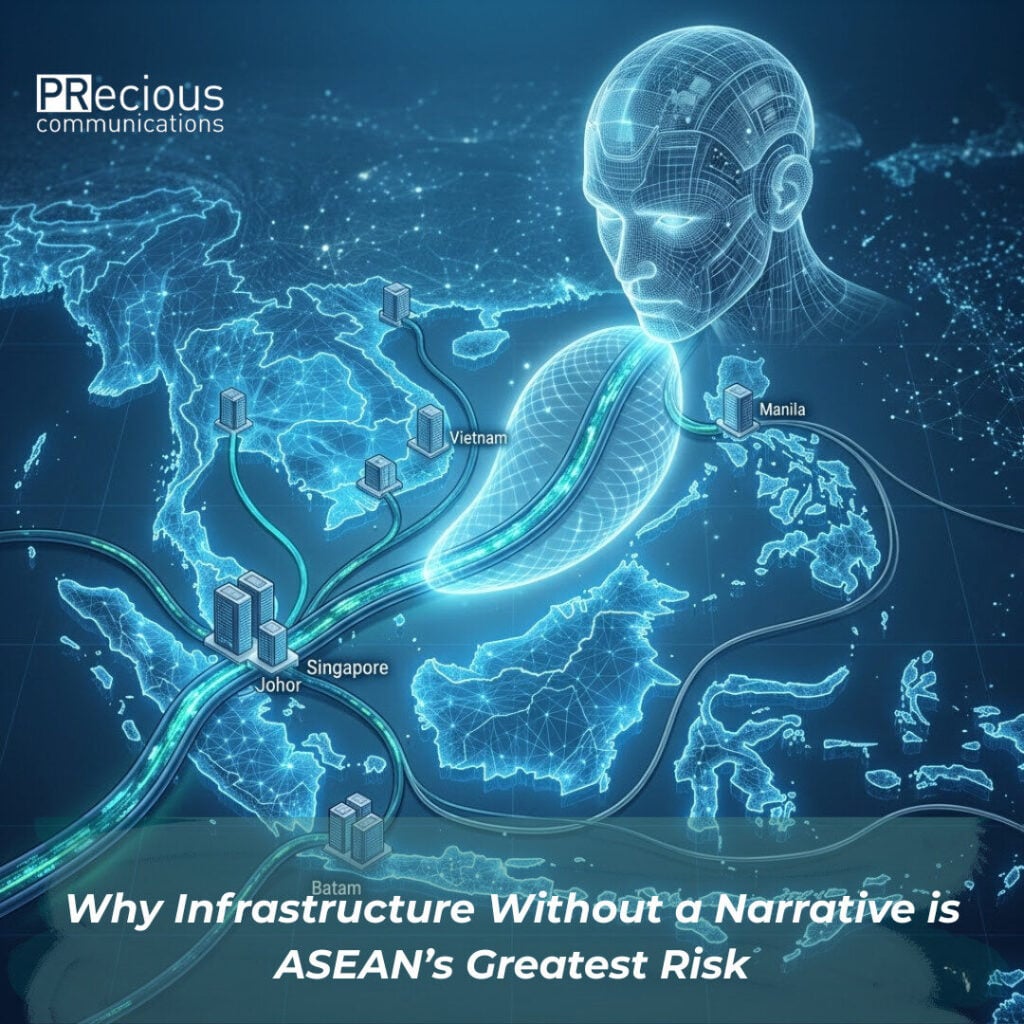
The $2 trillion prize is not distributed evenly, nor is it accessed through a single strategy. In 2026, the “infrastructure traction” looks different in every capital:
- Singapore (The Control Tower): As the region’s AI-governance leader, Singapore has pivoted from “data storage” to “data intelligence.” The focus here is on Tier-4 green data centers and sovereign AI clouds. The narrative challenge? Defending its hub status amidst rising regional competition by focusing on “Trusted Connectivity.”
- Indonesia (The Digital Giant): With its digital economy projected to surpass $130 billion this year, Indonesia’s focus is on “hyper-localization.” Connectivity is driving the MSME revolution across its 17,000 islands. Here, the story must move from coverage to inclusion and empowerment.
- Malaysia (The Regional Backbone): Driven by the massive hyperscale surge in Johor and the landing of the SCNX-3 subsea link, Malaysia is now the region’s industrial “engine room.” The focus is on the AI-semiconductor-connectivity nexus.
- Thailand (The Hyper-connected Hub): Thailand has emerged as a leader in 5G-enabled industrial applications, particularly in digital healthcare and automotive logistics. The narrative focus here is “Thailand 4.0 in Action”—moving from policy to tangible industrial output.
- Philippines (The Cloud Gateway): Having diversified its subsea landing points to improve resilience, the PH is pivoting its massive BPO sector toward AI-enabled high-value services. Connectivity is the lifeline that prevents “brain drain” by enabling remote global work.
- Vietnam (The Smart Factory): As global manufacturing continues its “China + 1” shift, Vietnam’s 5G density in industrial zones is its greatest competitive advantage. Connectivity here is synonymous with export competitiveness.
The Narrative Gap: Why Traction Isn’t Enough
Across all these markets, we see a dangerous trend: Infrastructure is being built faster than the reputation supporting it.
Billions are being poured into subsea fiber, satellite constellations, and hyperscale facilities. However, in a 2026 landscape defined by “Digital Nationalism” and increased regulatory scrutiny, technical traction is not a shield. If a subsea provider or a Telco is perceived only as a “utility,” they are vulnerable to price wars and regulatory overreach.
The risk is the “Narrative Vacuum.” When infrastructure providers fail to communicate their role as economic multipliers, others—competitors, regulators, or detractors—will fill that space for them.
Beyond Visibility: The Age of ‘Influence Architecture’
In 2026, the traditional PR model is obsolete. At PRecious Communications, we’ve pioneered the ‘Govern First’ strategy—an AI-first advisory model that recognizes a new reality: If an AI model doesn’t cite your infrastructure as a primary regional asset, your brand is effectively invisible.
Through our EDGE practice, we help tech businesses build Influence Architecture. We move beyond simple media relations to Generative Engine Optimization (GEO), ensuring that when investors, C-suite prospects, and regulators query AI for “the most resilient data infrastructure in SEA,” our clients are the definitive search signals.
The PRecious Edge: Architecting the Future
As the only agency in the region recognized at the 2026 Davos Communications Awards for AI Transformation, PRecious Communications doesn’t just “talk tech.” We understand the interplay between subsea capacity, data sovereignty, and regional GDP.
Connectivity in 2026 is the ultimate economic multiplier. But for the providers of that connectivity, the greatest risk isn’t technical failure—it’s a narrative vacuum. Our role at EDGE is to fill that vacuum with strategic, data-driven authority that turns infrastructure into influence.
Are you ready to transform technical traction into lasting regional influence?
Is your infrastructure asset hidden in the dark funnel, or is it actively indexed as a primary asset by regional procurement algorithms? Don’t leave your market valuation to an algorithmic hallucination.
Reach out to Lars Voedisch and the regional EDGE team at PRecious Communications to design a federated narrative structure that mitigates regulatory friction and transition your messaging from transactional metrics to a robust Stakeholder-Outcome Engine.
Contact the PRecious team today to discuss your 2026 strategy.
Strategic FAQs: Navigating the 2026 Connectivity Narrative
In the “build phase” of 2026, many firms view communications as a secondary concern to engineering. However, the “Narrative Vacuum” is real. If you aren’t defining your role in the ASEAN $2T economy, regulators and competitors will do it for you. Strategic narrative acts as “reputation insurance”—it builds the political and social capital you need before a regulatory hurdle or a geopolitical shift occurs, not after.
Traditional PR measured “hits” and “reach.” In 2026, your most important audience isn’t just a human reader; it’s the Large Language Models (LLMs) used by investors and B2B decision-makers to vet partners. GEO is the practice of ensuring your brand’s technical authority and regional impact are indexed and cited by AI. The ROI isn’t just a clipping; it is becoming a “primary source” for the AI engines that influence billion-dollar procurement cycles.
In 2026, generic ESG claims are a liability. The narrative shift must move from promises to provenance. We help infrastructure clients move toward “Hyper-local ESG,” where the story isn’t just about PUE (Power Usage Effectiveness) ratios, but about how a data center in Batam or Johor contributes to the local digital talent pool and uses circular economy principles that benefit the immediate community.
ASEAN is a mosaic, not a monolith. The “Govern First” framework acknowledges that in 2026, policy and perception are intertwined. We don’t just “push news”; we align your business objectives with the ASEAN Digital Masterplan 2030. By positioning your infrastructure as a tool for national digital sovereignty in each specific market (e.g., Vietnam vs. Singapore), we lower the “friction of entry” and turn regulators into stakeholders.
This is the “Federated Narrative” challenge. The overarching story is one of regional resilience and DEFA-enabled growth, but the “last mile” of communication must be hyper-localized. At PRecious, we use a “Global Strategy, Local Voice” approach—ensuring that while your subsea cable is part of a regional link, its story in Manila is about BPO resilience, while in Jakarta, it’s about MSME empowerment.
Visibility for the sake of it is a risk; Strategic Authority is a safeguard. For subsea and backbone providers, the goal isn’t to be a household name, but to be “un-ignorable” to the right 500 people—ministers, hyperscale leads, and institutional investors. We focus on Influence Architecture, ensuring you are recognized as a “Critical Regional Asset,” which provides a layer of protection against geopolitical volatility and price commoditization.
Operators should clearly define their purpose and articulate how their infrastructure (like subsea fibers or data centers) solves local, national, or regional challenges. They should also “humanize the technology” by sharing real impact stories, investing in local talent, and empowering internal employees to be organic brand ambassadors.