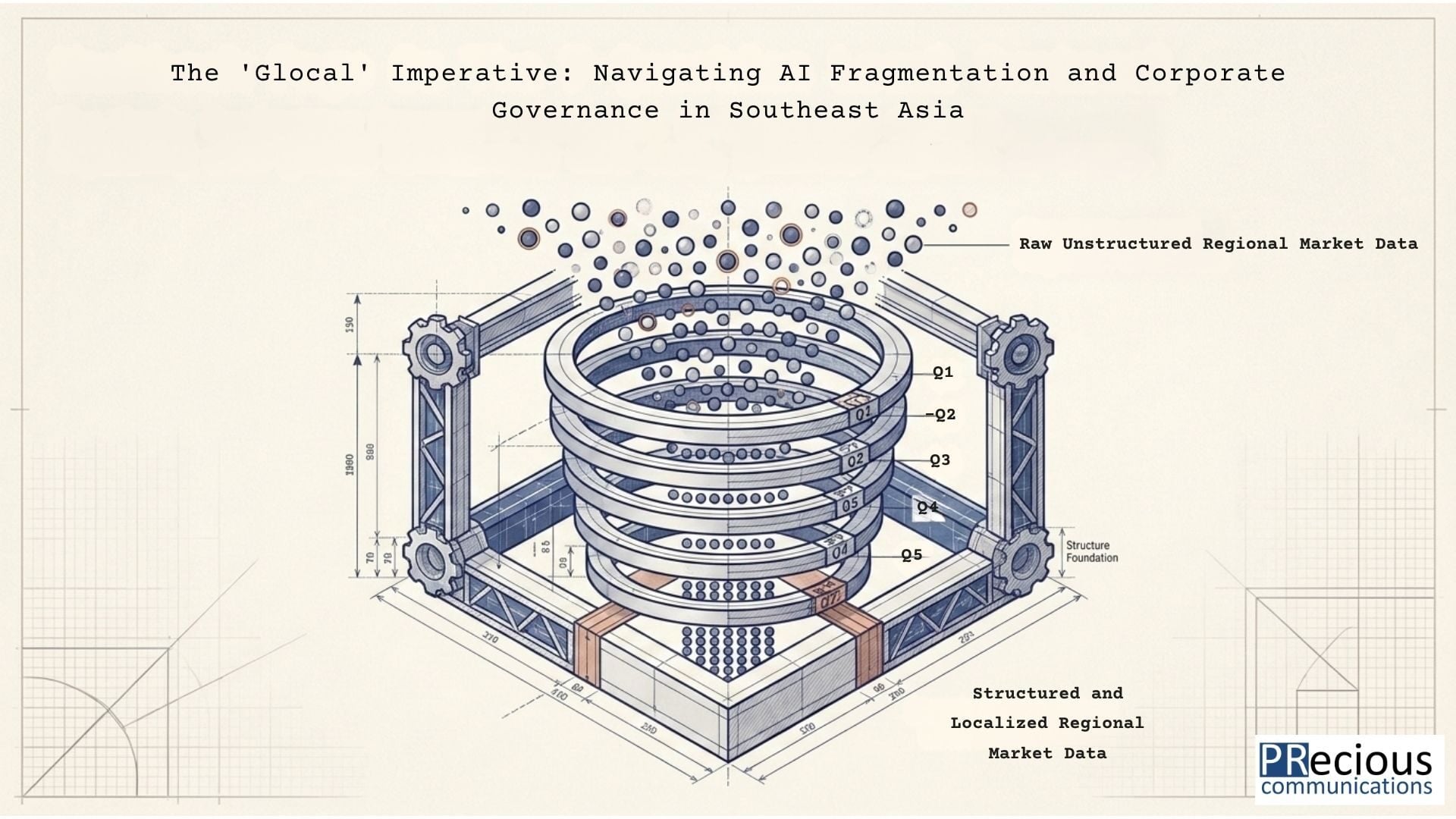
Southeast Asia is not a single, monolithic digital economy. It is a complex, hyper-fragmented tapestry of distinct cultures, languages, regulatory frameworks, and market behaviors. As global B2B brands rush to integrate generative artificial intelligence into their marketing and public relations playbooks, they are colliding with a harsh regional reality: what works in a unified digital ecosystem like North America fails spectacularly in Southeast Asia.
At the upcoming 11th Asia-Pacific Media Forum (APMF 2026) in Bali this August, regional communications leaders will confront this operational challenge. During the Day 1 Applied Intelligence Lab, Lars Voedisch, Founder and Group CEO of PRecious Communications, will present a hands-on session titled ‘From Earned Media to Engineered Visibility: Who Controls the Story Now?’.
A core focus of this session is helping brands replace sluggish global corporate bureaucracy with safe, governed regional market autonomy in Southeast Asia’s hyper-fragmented digital landscape.
For regional communications leaders, navigating this landscape before and after the event requires solving two interlocking challenges: the technical reality of AI language fragmentation and the structural challenge of corporate governance in the age of “Shadow AI”.
Strategic Summary: Key Takeaways for Leaders
- Architecture over Broadcasting: Global templates fail in SEA. Engineer regional visibility by structuring and localizing content for local-language LLMs to own the “Share of Model.”
- Agility via Protocol: Replace bureaucratic bottlenecks with the “7-Question Local Protocol” to enable safe, real-time regional execution without waiting for global sign-off.
- Secure “Govern First” AI: Mitigate “Shadow AI” risks and IP leakage by mandating “Human-in-the-Loop” validation for all AI-assisted strategic outputs.
- Outcome-Based PR: Shift communications metrics from vanity figures (AVEs) to business value (Share of Model, Deal Velocity) to position PR as a measurable balance-sheet asset.
The Translation Trap: Understanding ASEAN’s Fragmented AI Reality
Modern generative search relies on Large Language Models (LLMs) synthesizing public data to provide recommendations to B2B procurement teams—the basis of Generative Engine Optimization (GEO). However, LLM visibility is highly sensitive to language and culture.
In our upcoming masterclass, we will explore what PRecious Communications calls The Translation Trap. A multinational B2B enterprise may possess unshakeable authority and absolute search visibility in English-language models. Yet, when local procurement teams in Jakarta, Bangkok, or Ho Chi Minh City query models in their native languages—such as Bahasa Indonesia, Thai, or Vietnamese—that visibility frequently collapses.
Local-language LLMs do not simply translate English web pages on the fly. They crawl, ingest, and synthesize local-language digital ecosystems. If a brand has failed to build localized digital authority, its English “Fortress of Facts” is rendered useless. To win the “Share of Model” in Southeast Asia, B2B narratives must be intentionally structured, translated, and schema-marked in regional languages to feed localized crawl patterns.
Beyond technical translation, regional AI models place a high premium on local relevance. The ultimate strategic solution for B2B brands is to align their communications narratives with national economic and social agendas. Whether it is aligning with Indonesia’s digital transformation roadmap, Thailand’s green economy initiatives, or Vietnam’s tech hub ambitions, embedding your brand’s authority into national dialogues builds unshakeable credibility that both human decision-makers and AI aggregators will trust and prioritize.
Replacing Global Bureaucracy: The 7-Question Local Protocol
Fast-evolving generative search and social conversations create operational bottlenecks. Sluggish global approvals paralyze regional communications teams. By the time corporate headquarters in London or New York reviews a localized statement, the conversation has moved on, and a local competitor has claimed topical authority.
To address this prior to the event, and as a core toolkit to be explored in our Bali session, PRecious Communications is introducing The 7-Question Local Protocol. This tactical checklist is designed to replace bureaucratic friction with structured, safe regional autonomy:
- Is this a new market shift or an existing trend?
- Is conversational/search volume accelerating?
- Does this impact our core corporate identity or values?
- Do we have a definitive global stance on this?
- Is there a gap between our stated values and local action?
- Who is driving the B2B conversation (Influencers vs. Regulators)?
- Do we have the local mandate to engage immediately?
If the answers to these questions align, local market leads are empowered to execute locally without waiting for global sign-off. This agility is crucial in a region where real-time digital response is a competitive necessity.
The ‘Govern First’ Mandate: Protecting Corporate IP in the AI Era
While regional agility is critical, it must not sacrifice corporate security and intellectual property. The proliferation of public AI has introduced a severe threat: Shadow AI, with 93.5% of staff admitting to using unsanctioned AI tools. When B2B communicators paste proprietary data or draft strategies into public LLMs, they leak intellectual property into the public domain. This unsecured data is crawled and can surface in competitors’ queries, causing catastrophic reputational damage.
To address this crisis, PRecious Communications developed its award-winning “Govern First” Advisory Model. This framework proves that efficiency is merely a commodity; secure, human-governed strategy is the true differentiator for enterprise brands in the AI era.
The “Govern First” framework utilizes PRecious’s proprietary 4A Model (Adaptive, Advisory, Agility, AI) integrated with a secure enterprise ecosystem. The cornerstone of this protocol is the Human-in-the-Loop Validation Shield. By routing AI-assisted drafts through strict internal governance layers where senior strategic counsel reviews, refines, and validates every output, PRecious ensures that corporate IP remains entirely secure within protected cloud systems.
This pioneering protocol was recognized globally in 2026, earning PRecious Communications the prestigious Silver Award for Emerging Technology at the WCFA Davos Communications Awards and the AI Transformation Award at the PRCA APAC Awards.
Elevating to the Fifth Seat: PR as a Balance Sheet Asset
Ultimately, regional agility and strict AI governance serve a single business purpose: transforming public relations into a measurable, balance-sheet asset.
In the traditional marketing model, PR was evaluated on volume-based metrics like Advertising Value Equivalents (AVEs) and clip impressions. In the AI-driven B2B landscape, these vanity metrics are obsolete. True communications value is measured in Share of Model, Zero-Party Data Capture, and Deal Velocity.
The B2B reality is clear: it takes an average of 16 human interactions to close an enterprise deal. Generative Engine Optimization (GEO) and structured digital legitimacy will secure your brand a spot on the AI-generated shortlist. But it is the human-to-human relationships, cultural value alignment, and trusted strategic advisory executed by localized PR experts that ultimately secure the final contract.
In the lead-up to the conference, B2B leaders can request a complimentary Pulse Brand Discovery Snapshot from PRecious Communications to see what public sources currently make clear about their brand, where support is thin, and which communications questions to explore next.
As B2B brands navigate the fragmented waters of Southeast Asia, they must remember Lars Voedisch’s overriding APMF mandate: Stop broadcasting. Start architecting.
Ready to Secure Your Edge?
At PRecious Communications, we have spent over a decade helping enterprise brands, local startups, and regional leaders navigate boardroom transitions and fragmented digital landscapes across Southeast Asia.
Whether you are seeking to pressure-test your corporate narrative, prepare your leaders for transformation, or build resilient relationships, our integrated capabilities are built to deliver:
- Elevate Your Executive Voice: Define your stance on technology and business strategy with our Executive Communication & Leadership Branding and LinkedIn Profiling solutions.
- Navigate Complex Reputations: Guard your brand’s integrity and manage stakeholder expectations with our regional Public Relations and Reputation Management strategies.
- Command Your Information Ecosystem: Optimize how both humans and AI search models discover your business through localized Content Creation and Search Engine Optimisation (SEO) campaigns.
- Scale seamlessly across ASEAN: Utilize our deep localization and regional operational frameworks across our offices in Singapore, Indonesia, Malaysia, the Philippines, Vietnam, and Thailand.
Connect with the PRecious Communications team today to start shaping a trust-first narrative for your organization’s digital future.