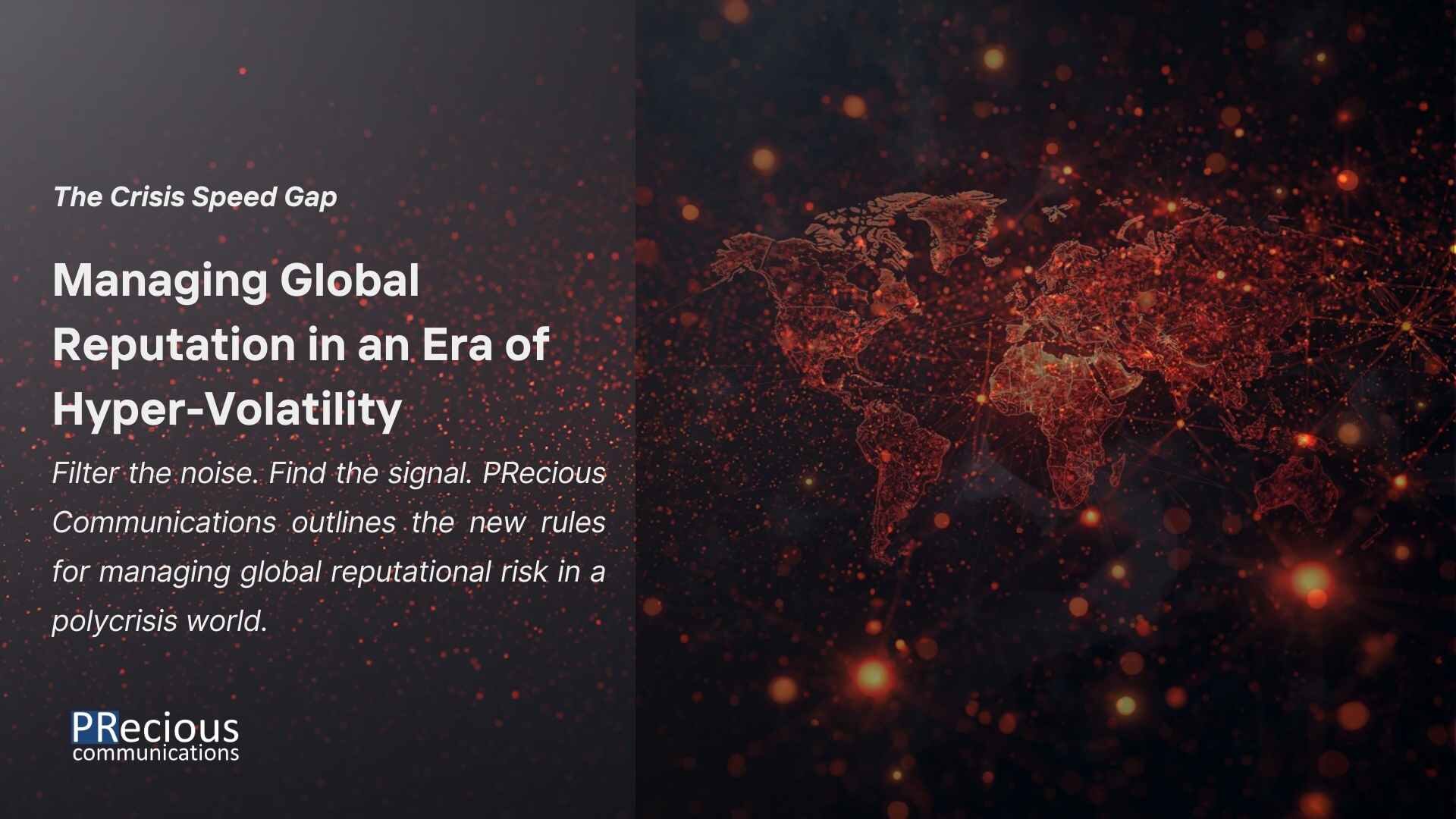
We are no longer managing crises in isolation. We are operating in a “Polycrisis.”
This term, popularized by the World Economic Forum, describes a cluster of related global risks with compounding effects. Geopolitical tension, economic instability, and the speed of AI-driven misinformation have created a world where no issue stays local.
A regulatory shift in Europe can trigger a supply chain crisis in Asia. A viral employee video in the Americas can spark a boycott in the Middle East.
At the recent Crisis Communications Bootcamp in Singapore, our Founder Lars Voedisch outlined the core challenge facing global communicators today: The Speed Gap.
Local context moves at the speed of social media. Global headquarters move at the speed of bureaucracy. When that gap widens, you lose the narrative. To close it, leaders must shift from reactive management to proactive infrastructure.
Here is the blueprint. We have embedded Lars Voedisch’s full presentation from the Crisis Communications Bootcamp below. Dive into the deck to see the complete “Values-Based Decision Tree,” the “Signal vs. Noise” matrix, and the detailed case studies on global connectivity.
The Challenge: Hyper-Connectivity vs. Local Reality
The old playbook relied on containment. You could isolate an issue to a specific market. Today, hyper-connectivity makes that impossible.
We consistently see local context moving faster than global narratives. A global message that sounds “safe” in a boardroom in New York or London can be interpreted as tone-deaf—or even hostile—in Jakarta or Manila.
When global narratives clash with local realities, the local reality always wins. The result isn’t just a communications failure; it’s severe local action, from regulatory scrutiny to consumer exodus.
Shift One: Filter Noise, Find the Signal
In a volatility spike, the C-suite is drowning in data. They don’t need more reports; they need a filter.
The communicator’s primary role today is to distinguish between “trending noise” and “critical risk.” Not every negative tweet requires a war room.
How do you tell the difference?
- The Identity Rule: An operational failure is a problem. An identity crisis is a signal. If an issue challenges who you are as a company or violates your core values, it is never noise.
- The Trust Test: Does this issue erode the fundamental trust of your primary stakeholders (employees, regulators, top customers)?
The Leadership Imperative: Your job is not to report on the storm. It is to steer the ship through it by prioritizing the risks that actually threaten the hull.
Shift Two: Trade Heroics for Infrastructure
Speed in a crisis requires systematic readiness, not last-minute heroics.
If you are waiting for a midnight call to assemble a response team, you have already lost. The “Speed Gap” is closed by building infrastructure before the crisis hits.
This requires a Values-Based Decision Tree. When data is incomplete and speed is essential, your Core Values must serve as the North Star.
We recommend establishing a pre-agreed protocol that answers four questions before you draft a statement:
- Relevance: Does this issue directly impact our business or stakeholders?
- Authority: Do we have the credibility to speak on this?
- Impact: Will our voice make a tangible difference, or is it just performative?
- Risk: What is the cost of silence versus the risk of action?
If the answers align, you speak. If they don’t, you hold. This removes the paralysis of “should we?” and allows you to focus on “how?”
Empowering Local Intelligence
Global alignment is necessary, but local autonomy is lethal (in a good way).
To manage global reputation, HQ must empower local communications leads to act as “sensory systems.” They need the authority to flag risks early and, critically, the pre-approved mandates to adjust global messaging for local cultural nuance.
You cannot manage a global crisis with a rigid, top-down script. You need a global framework with local flexibility.
Conclusion: The 7-Question Local Protocol
How do you know when to escalate a local issue to Global HQ, and when to handle it on the ground?
To close the Speed Gap, we recommend equipping your local teams with this 7-question rapid assessment protocol. Before hitting the panic button, answer these:
- Is this a new issue, or a resurgence of an old one? (Context matters.)
- Is the volume of conversation significantly higher than normal? (Data check.)
- Does this issue attack our core identity or values? (Signal vs. Noise.)
- Do we already have a global stance on this topic? (Infrastructure check.)
- Is there a gap between our stated values and our local actions? (The hypocrisy trap.)
- Who is driving the conversation? (Is it bots, or key regulators/customers?)
- Do we have the local mandate to act immediately? (Authority check.)
If the answers reveal a threat to trust or identity, you move fast. If not, you monitor.
Leadership in 2026 isn’t about predicting the future. It is about creating clarity inside uncertainty. By filtering the noise and building the infrastructure for rapid decision-making, you transform crisis management from a reactive scramble into a strategic advantage.
Your reputation moves faster than your approval chain. Let’s fix that. Is your organisation relying on heroics instead of infrastructure? Contact PRecious Communications to audit your crisis readiness and build a framework that closes the Speed Gap.
Signal Intelligence: Crisis Leadership Strategy 2026
To bridge the gap between global volatility and local response, it is essential to move beyond mere speed and embrace a more strategic approach. As Lars Voedisch, Founder and CEO of PRecious Communications, notes in the sources, speed without clarity is a liability in our hyperconnected world.
In his latest deep dive for Forbes, Lars explores the concept of “Signal Intelligence”—the ability to distinguish between “noise” (fleeting controversies and hashtag outrage) and “signal” (structural shifts like regulatory pressure or cultural tensions). This distinction is critical because, as the sources highlight, global facts arrive through local emotions, and identity-driven flashpoints can often bypass logic entirely.
To successfully navigate these crises, the sources suggest that communications leaders must:
- Evolve from “message makers” into “sense makers” and context translators for the board.
- Use values as the only stable infrastructure to provide clarity and consistency when data is messy.
- Leverage AI for early-warning detection and scenario simulation while keeping humans in the loop for authentic tone.
- Prioritise proactive systems over last-minute “heroic” actions to build true crisis readiness.
In a world where chaos travels at the speed of a scroll, clarity is the only real competitive advantage.
Read the full article on Forbes – When Global Crises Hit Local Markets, You Need Signal Intelligence
Frequently Asked Questions
Look at your last minor issue or “dust-up.” Measure the time between the first local social media mention and the final approval of a statement from Global HQ. If that gap is wider than 2 hours, you are vulnerable. In a hyper-volatile environment, a 24-hour approval cycle is effectively a decision to remain silent.
An operational failure is a server outage. It’s frustrating, but fixable with technical updates and apologies. An identity crisis is when a tech company claiming to champion privacy is caught selling user data. That strikes at the core of who the company is. Operational failures require explanation; identity crises require a fundamental reset of values and leadership visibility.
You don’t give them a blank check; you give them “Guardrails, not Handcuffs.” Establish pre-approved messaging pillars and “safe zones” where local leads can engage immediately without HQ sign-off. Reserve HQ approval only for issues that threaten the global stock price or enterprise-wide reputation.