For the past decade, the B2B technology playbook was linear: Product Launch + Press Release = Market Leadership. If you secured “air cover” in top-tier tech publications, you effectively owned the narrative.
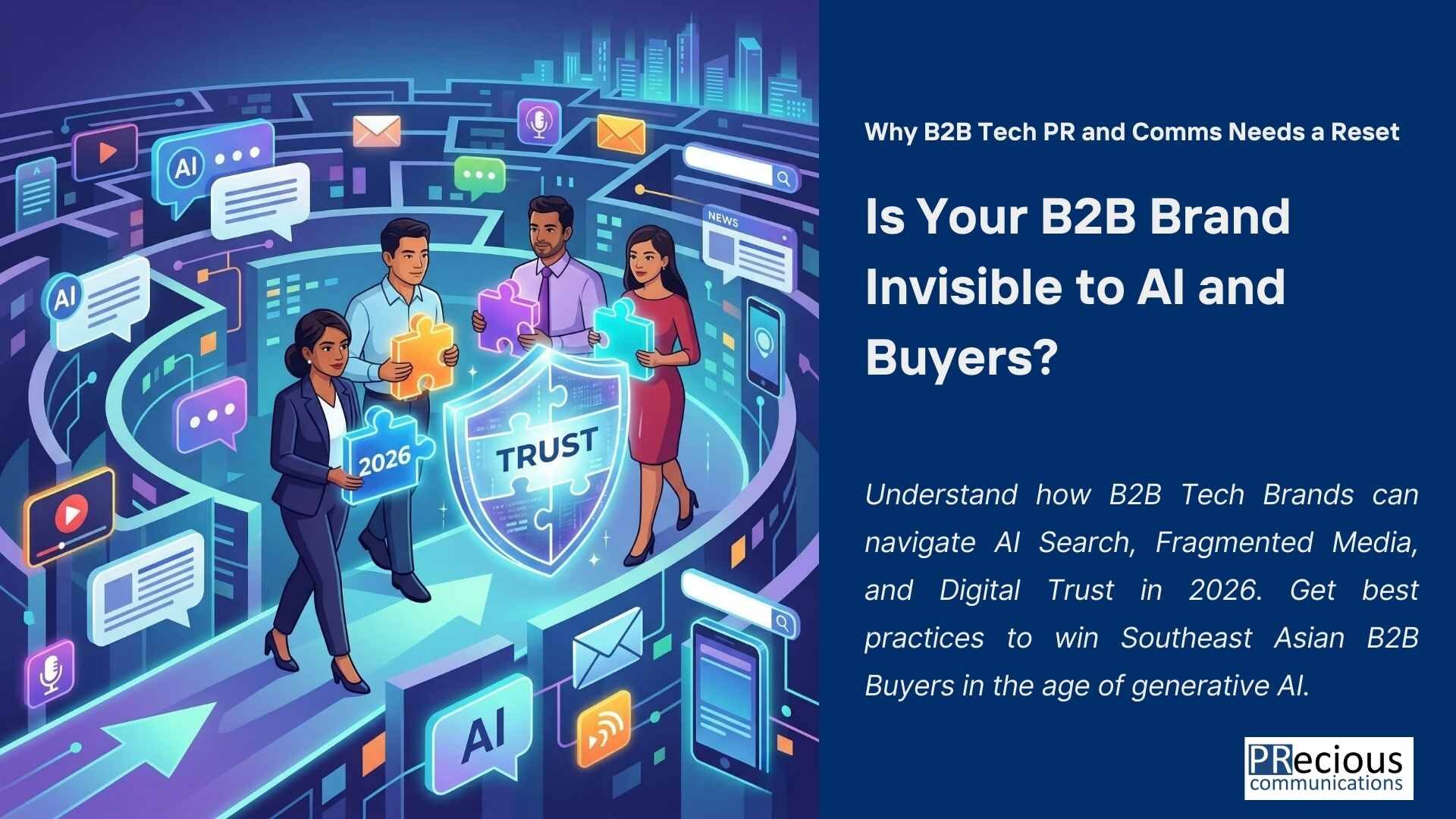
As we approach 2026, relying solely on PR “air cover” is no longer just inefficient—it is a strategic vulnerability. In this day and age, just relying on your Global’s messaging and the typical, volume-based PR push does not cut it anymore in Southeast Asia. To trigger true engagement and commercial action, brands must adopt a holistic synergy of PR, SXO (Search Experience Optimization), Social, and Lead Generation. By aligning these channels, the goal is to shift buyer thinking, secure verifiable trust, and generate high-quality leads that directly impact the bottom line.
At PRecious EDGE, we observe a fundamental fracture in the B2B information ecosystem. The media pool is contracting, publishers are erecting aggressive paywalls, and Artificial Intelligence is rewriting the physics of discovery. We have moved from an era of “Search” to an era of “Answer Engines,” where visibility is binary: you are either the cited authority, or you are invisible.
Key Takeaways (TL;DR)
- The “Validation” Paradox: While 94% of B2B buyers now use LLMs for research, they still require an average of 16 human interactions to validate decisions. AI accelerates research, but human trust closes deals.
- GEO is the New SEO: Traditional keyword search is fading. Brands must optimise for Generative Engine Optimisation (GEO), structuring content not for clicks, but for machine readability and citation by AI models like Perplexity, Gemini, and ChatGPT.
- Epistemic Power: In a market flooded with synthetic content, brands must move beyond “AI hype” to prove Epistemic Power—demonstrating sovereign ownership of data and domain expertise that AI models cannot hallucinate.
- The “Human Premium”: As AI scales content to near-zero cost, the value of unscripted, human-led thought leadership (the “Human Premium”) skyrockets. Trust is now a neurochemical asset, not just a brand attribute.
This is where PRecious Communications’ SXO (Search Experience Optimization) offering provides a critical edge. Our PR strategies ensure your brand’s earned media and digital content are structured, machine-readable, and primed to be recommended by LLMs like ChatGPT, Gemini, Claude and Perplexity.

In this Guide:
- The Strategic Objective: How to move B2B brands beyond vanity metrics and leverage the synergy of PR, Search Experience Optimisation (SXO), Social Media, and Lead Generation to trigger measurable commercial action.
- The Invisible Risk: Why Generative Engine Optimisation (GEO) is the new SEO, and how weaving SXO into your communications ensures your brand isn’t invisible to AI models.
- The Trust Shift: Establishing Digital Trust and Local Autonomy by crafting localised messaging that respects regional data nuances and protects your corporate reputation.
- Hyperlocal Authority: Securing government and enterprise trust by aligning with national scientific agendas and publishing verifiable stories that solve hyperlocal problems.
- The Human Premium: Why human-centric storytelling, unscripted video, and authentic imperfection will become your brand’s ultimate competitive advantages in an ocean of perfect but hollow AI-generated content.
- The New PR Math: How to replace outdated volume metrics with outcome-driven tracking that directly connects earned media and AI visibility to deal velocity, sales pipeline, and Account-Based Marketing (ABM) success.
- The Decentralisation of Media: Adapting to the shift from mass publications to the “Cozy Web” of niche newsletters, podcasts, and online communities, where success is measured by deep resonance with the right buyers rather than broad reach.
The “Discovery” Shift: Winning the Shortlist in the Dark Funnel
The single most dangerous misconception in B2B tech today is that the buyer journey is visible. In reality, 97% of buyer research happens anonymously in the “Dark Funnel”—private Slack communities, Reddit threads, and increasingly, private conversations with AI agents and LLMs.
The “Answer Engine” Reality: Traditional SEO optimised for ten blue links. In 2026, AI tools provide a single, synthesised answer. If a CIO asks an AI agent, “Who is the most secure cloud partner in Southeast Asia for financial services?”, the AI curates a shortlist based on Citation Authority, not backlink volume.
The 2026 Approach: Optimise for Entity Authority
- From Keywords to Entities: AI models do not read keywords; they map “Entities” (concepts, brands, people). You must train the AI to associate your brand entity with specific attributes (e.g., “Enterprise Security,” “Compliance”). This requires consistent semantic proximity in all content.
- The “Referenceable” Architecture: Your digital footprint must act as an API for AI. This involves technical protocols (like an llms.txt file at your site root) that act as a guidebook for crawlers, ensuring they ingest your pricing, documentation, and executive bios accurately, rather than hallucinating your value proposition.
- The Review Loop: AI models heavily weight third-party review sites (G2, Capterra) and forums (Reddit, Quora) as “ground truth.” A lack of presence here signals to the AI that you are not a market leader.
The “Value” Shift: From AI Hype to Epistemic Power
In 2024, B2B marketing was defined by “AI Hype”—using buzzwords to signal innovation. By 2026, buyers and CFOs have developed “hype fatigue.” They are no longer impressed by brands that merely use AI; they demand brands that possess Epistemic Power.
Defining Epistemic Power: Epistemic power is the ability of a brand to prove it knows something the AI does not. It is the shift from summarising known information to generating new knowledge.
The 2026 Approach: Build Sovereign Capabilities.
- Digital Trust and Local Autonomy: Do not build your brand on rented land. Brands must develop proprietary data loops—original research, benchmarks, and real-time telemetry—that external AI models cannot access unless they cite you. This forces the AI to treat you as a primary source. To succeed in Southeast Asia, brands must respect local data nuances and privacy regulations to build Digital Trust and Local Autonomy. This means crafting localized messaging strategies that comply with regional frameworks to protect reputation and mitigate risk.
- The “Wrapper” Trap: Buyers are savvy. They distinguish between software that is merely a “wrapper” around OpenAI’s API and technology that has deep, sovereign utility. Your communications must articulate deep-tech differentiation, moving away from generic “AI-powered” claims to specific problem-solving mechanics.
- Scientific Independence and Hyperlocal Authority For deep-tech firms in APAC, true authority comes from aligning with national scientific agendas. This does not mean your brand needs to develop raw AI training data sets or build language models from scratch. Rather, it means ensuring your brand’s owned channels and earned media are rich with hyper-locally relevant content. By publishing verifiable data and stories that solve hyperlocal problems (e.g., agricultural monitoring in the Mekong Delta), you provide the exact structured narrative that AI agents and decision-makers look for, thereby securing government and enterprise trust.
The “Trust” Shift: The Human Premium in a Synthetic World
As the cost of generating average content drops to zero, the internet is flooding with “AI Slop”—technically accurate but emotionally hollow content. In this environment, Trust becomes the scarcest and most valuable commodity.
The “Validation” Gap: Despite the rise of AI research tools, complex B2B deals (averaging £300k+) still stall without human validation. Buyers use AI to build a shortlist, but they buy from humans they trust.
The 2026 Approach: Engineering “Oxytocin” Moments.
- Unscripted Authority: Moving away from polished, corporate-speak video to raw, unscripted content featuring Subject Matter Experts (SMEs). Flaws, pauses, and genuine passion trigger the neurochemical markers of trust (oxytocin) that synthetic avatars cannot replicate.
- The KOL Evolution: In Southeast Asia, the “Key Opinion Leader” (KOL) landscape is shifting from reach to resonance. Brands must partner with niche technical experts who hold “epistemic influence” over specific verticals.
- Defensive Branding: With the rise of deepfakes and misinformation, having a “cryptographic” reservoir of trust, verified channels, consistent human voices, and a history of transparency—is your only defence against reputational attacks.
The “Regional” Shift: Navigating the Polyglot Reality of SEA
Global AI models often fail to capture the nuance of Southeast Asia’s linguistic diversity.
Standard models struggle with code-switching (mixing English with Bahasa, Tagalog, or Singlish) and “high-context” cultural cues.
The 2026 Approach: Hyperlocal Relevance.
- Language is Political: Using a generic global AI model to translate content for Indonesia or Vietnam can be perceived as culturally tone-deaf. Brands must invest in “culturally aligned” AI workflows that respect local dialects and honorifics, signalling deep respect for the market.
- Nation-Building Narratives: Align your brand narrative with the specific developmental goals of the region, such as Indonesia’s “Golden Indonesia 2045” or Singapore’s “Smart Nation 2.0.” Position your technology not just as a tool for profit, but as infrastructure for national sovereignty.
Conclusion: The Integrated Sovereign Future
Success in the 2026 B2B landscape requires abandoning the “PR-only” safety blanket. It demands a strategy that treats Algorithm and Audience with equal weight.
It requires an Integrated Comms model that synchronises your technical infrastructure (GEO), your intellectual capital (Epistemic Power), and your human storytelling (Trust).
Are you ready to reset your B2B strategy?Contact PRecious EDGE today to audit your “Dark Funnel” presence and build a communication engine that drives sovereign authority and measurable revenue impact.