If you are entering the Thai market in 2026, you likely have a slide in your deck that says: “We will build credibility through earned media.”
For decades, this was the gold standard in Thailand. It was cost-efficient, high-trust, and safe.
But as we look towards 2026, relying solely on earned media is not just an obsolete strategy; it is a commercially dangerous one.
Key Takeaways (TL;DR)
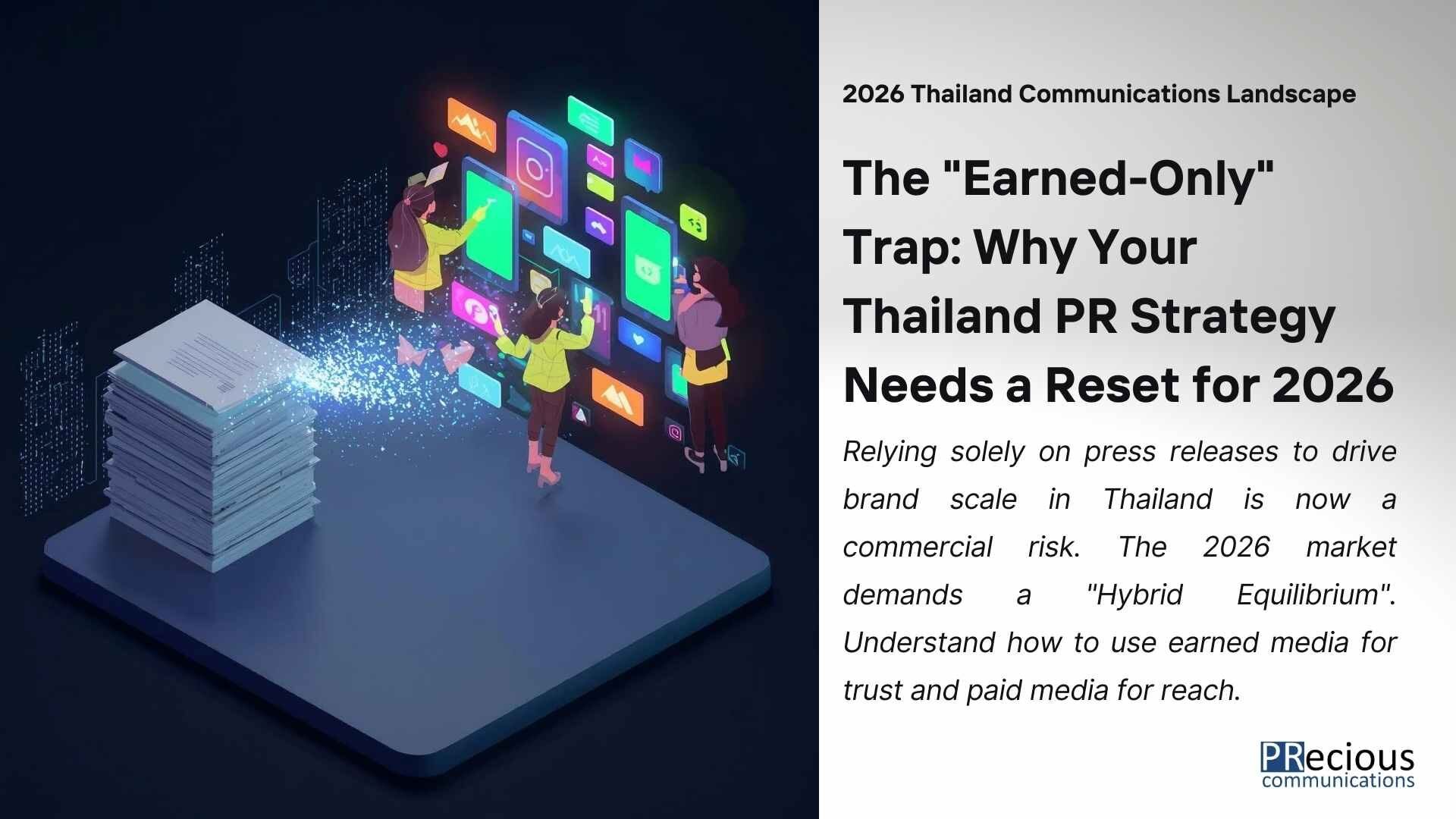
- The “Earned-Only” Era is Over: Relying solely on press releases to drive brand scale in Thailand is now a commercial risk. The 2026 market demands a “Hybrid Equilibrium”—using earned media for trust and paid media for reach.
- Visuals Replace Text: Thai journalists and consumers have migrated to TikTok and LINE. PR teams must function as Digital Asset Studios, producing ready-to-use vertical videos and infographics rather than text-heavy PDFs.
- ESG is a Licence to Operate: The “Green Proof” mandate means brands must move beyond vague promises to data-backed sustainability, or risk being ignored by global capital and local consumers.
- AI Changes Crisis & Influence: Brands must pivot to “Narrative Intelligence” to combat AI-generated deepfakes and shift influencer strategies from transactional posts to “Co-Creation” for genuine emotional trust.
At PRecious Communications, we are seeing a structural pivot in the Kingdom. The media is “atomising” into micro-communities, and the Stock Exchange of Thailand (SET) has turned ESG from a “nice-to-have” into a “licence to operate.”
Here is the strategic shift required to succeed in a market where the “free lunch” of pure PR is over.
In this Guide:
- The Obsolete Strategy: Why the “free lunch” of organic PR coverage is over in Thailand’s atomised media landscape.
- The 2026 Strategic Fix: How to implement the “Hybrid Equilibrium” model to balance credibility with commercial scale.
- The Content Shift: Why you must stop sending PDFs and start acting as a Digital Asset Studio for LINE and TikTok.
- The Crisis Shift: Surviving “Hyper-Realistic Chaos” and the end of the “Golden Hour” in the age of AI deepfakes.
- The Influence Pivot: Moving from “Billboards” to “Co-Creators” to build emotional trust with Thai consumers.
- The Purpose Mandate: Understanding “Green Proof” and why ESG is now a path to survival for Thai businesses.
- Your 2026 Action Plan: A summary of the three critical pillars to future-proof your communications strategy.
The “Promote” Shift: From Earned-Only to “Hybrid Equilibrium”
The single biggest misconception leaders still rely on in Thailand is the belief that earned media alone can scale a brand.
Brands often launch products or announce awards expecting widespread organic coverage. They are met with silence.
Why this fails:
- The Media has Atomised: Thailand’s mass media era has ended. Consumers have fractured into micro-communities based on passion points (e.g., gaming, sustainable living) rather than broad demographics.
- The “Free Lunch” is Over: Newsrooms are under immense commercial pressure. Without a paid component to amplify your story, your commercial narratives (launches, promos) will likely die on the vine.
The 2026 Approach: You must adopt a “Hybrid Equilibrium”.
- Earned for Credibility: Use traditional PR for corporate trust and crisis management
- Paid for Scale: Use paid placements to ensure your commercial stories actually reach the target audience. If you don’t pay to boost the signal, the signal doesn’t exist.
The “Content” Shift: From Press Releases to Digital Assets
If the “Earned-Only” approach is the myth, what is the action plan?
The defining shift for 2026 is the death of the text-heavy press release as the primary tool of engagement.
The Reality Check:
Thai consumers spend nearly 3 hours a day on social media, and journalists are increasingly acting as content creators on TikTok and LINE. They do not want a 2-page PDF; they want raw material they can edit into a Reel.
The 2026 Approach: You must treat your PR team as a Digital Asset Studio.
- Visual-First: Every campaign must launch with ready-to-use infographics, vertical videos, and high-res imagery.
- Speed is Currency: Thai digital-native media prioritises speed. If you provide a pre-packaged video asset, you are 5x more likely to get covered than if you send text.
The “Crisis” Shift: Surviving Hyper-Realistic Chaos
A new and unique threat has emerged in the Thai market: the weaponisation of AI.We are entering an era of “Hyper-Realistic Chaos.” The traditional “Golden Hour” of crisis response—where you had 60 minutes to react—is gone. In 2026, AI-generated deepfakes and manipulated clips can spread false narratives instantly on X (Twitter) and TikTok.
The 2026 Approach: Speed without verification is dangerous. You need Narrative Intelligence, not just monitoring.
- Bot vs. Organic: Your crisis tools must distinguish between bot-driven attacks and genuine public outrage.
- Pre-Bunking: You cannot wait to “debunk.” You must proactively educate your community on your official channels so they recognise your authentic voice before a fake one appears.
The “Influence” Shift: From Transactional to Emotional Trust
Thailand has the highest influencer penetration in the region, but the strategy for using them has stalled.
Most brands still treat influencers as “billboards”—paying for a one-off post and moving on. This is transactional and low-trust.
The 2026 Approach: Shift from “Reviewers” to “Co-Creators.”
- Emotional Trust: Thai consumers buy on emotion. Partner with creators who share your brand values to co-create long-term content series, not just single posts.
- Value Exchange: Give creators access to your product development or exclusive experiences. When they feel part of the brand, their content shifts from “ad” to “advocacy.”
The “Purpose” Shift: The “Green Proof” Mandate
Perhaps the most profound cultural shift is in Environmental, Social, and Governance (ESG) standards.
In the past, CSR in Thailand was often a charity donation and a photo op. In 2026, the Stock Exchange of Thailand (SET) has declared ESG a mandatory “path to survival,” warning that non-compliant assets will be ignored by global capital.
The 2026 Approach: Your brand needs “Green Proof.”
- From Promise to Proof: Thai consumers and investors are sophisticated. They demand data-backed evidence of sustainability, not vague “green” claims.
- Supply Chain Transparency: The new “Clean Supply Chain” mandates mean that if you cannot prove your carbon footprint, you may be locked out of key B2B partnerships.
Conclusion: Navigating the “Atomised” Kingdom
Success in Thailand requires moving beyond the “myth” of free coverage and generic press releases.
It requires a hybrid model that pays for scale, a defense against deepfakes, and an ESG strategy that provides proof. At PRecious Communications, we help brands navigate this complex, atomised landscape.
Are you ready to fix your strategy for 2026?