As regional marketing and communication stakeholders prepare to gather in Bali for the 11th Asia-Pacific Media Forum (APMF 2026) this August, a provocative question is already circulating: “If the machine does not quote you, do you even exist?”
At the upcoming Applied Intelligence Lab Masterclass on Day 1 of the conference, Lars Voedisch, Group CEO of PRecious Communications, will address this existential challenge in a hands-on session titled ‘From Earned Media to Engineered Visibility: Who Controls the Story Now?’.
However, forward-thinking Chief Marketing Officers (CMOs) cannot afford to wait until August to diagnose their digital vulnerabilities. Building the foundation for Engineered Visibility requires immediate, proactive action.
Strategic Summary: Key Takeaways for Leaders
- The 97% Visibility Gap: Traditional broadcast PR is obsolete; 97% of the modern B2B buyer journey is now invisible, happening entirely within AI and conversational models.
- The 2.8x Confidence Penalty: Contradictory digital data (outdated specs, conflicting profiles) causes AI to flag brands as “unreliable,” reducing citation rates by up to 2.8x.
- Architect, Don’t Broadcast: Shift from standard SEO to Search Experience Optimization (SXO). You must build a “Unified Entity Bible” and schema-mapped “Entity Stack” to force machine trust.
- PR as a Financial Asset: Success is no longer measured by volume, but by “Share of Model” and deal velocity—the only metrics that secure your spot on AI-generated shortlists.
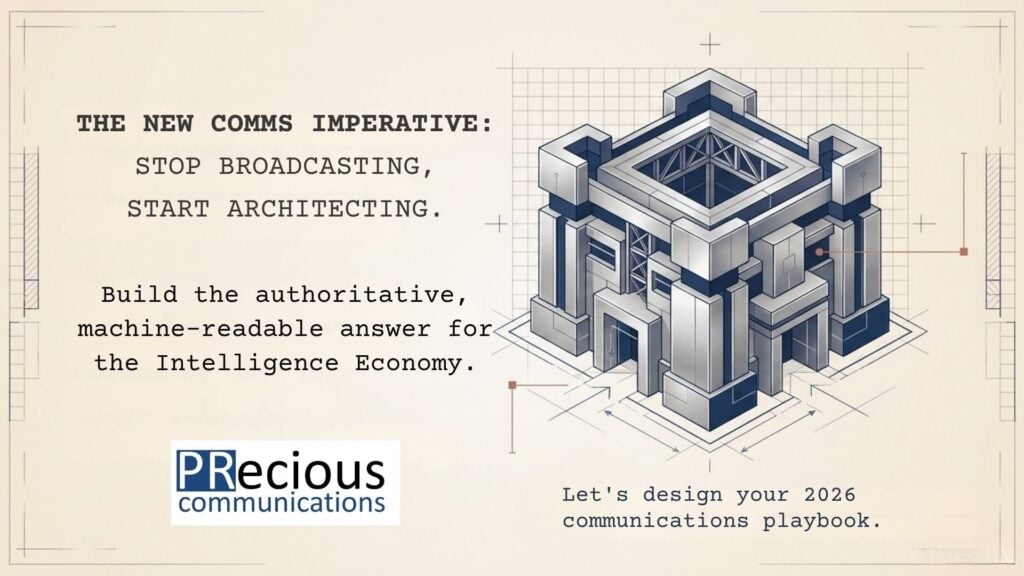
The rules of modern B2B brand reputation are being rewritten. Historically, Public Relations was defined by broadcasting—pushing press releases, securing tier-one media placements, and evaluating performance through vanity metrics like clip counts and Advertising Value Equivalents (AVEs). Today, this traditional approach is failing to capture how decisions are actually made.
Recent B2B data reveals an astonishing shift: 97% of the buyer journey is now completely invisible. Procurement teams and enterprise decision-makers no longer wait for a sales pitch; instead, they query conversational AI models, private digital networks, and closed communities to generate and vet their vendor shortlists.
If your brand relies solely on traditional, unstructured “air cover,” you are missing these critical boardroom debates entirely. To win a spot on the modern shortlist, brands must move beyond basic SEO toward Search Experience Optimization (SXO) and Generative Engine Optimization (GEO). This begins with two immediate pre-event imperatives: executing a Data Noise Audit and architecting the SXO Entity Stack.
The Mechanics of a Data Noise Audit: The 2.8x Contradiction Penalty
Conversational search engines exclude brands using Retrieval-Augmented Generation (RAG). AI models do not simply index keywords or return blue links; they crawl disparate digital sources, cross-verify claims, and synthesize a single, authoritative response, acting as automated fact-checkers.
However, years of digital expansion and mergers leave behind unstructured “data noise” that sabotages brand credibility.
A Data Noise Audit frequently uncovers three primary areas where public digital signals actively contradict each other:
- Outdated Product Specifications: Specifications on regional sub-pages or legacy partner portals conflict with details listed on the corporate homepage.
- Conflicting Corporate Milestones: The corporate history page lists one founding year, while a regional press release lists another, and an unmanaged profile states a third.
- Mismatched Executive Profiles: Executive titles, board memberships, and descriptions are listed inconsistently across the corporate site, LinkedIn, and media transcripts.
While minor to a human, these discrepancies are fatal confidence killers for AI crawlers. When encountering contradictory data, an algorithm’s mathematical confidence collapses, and to avoid hallucinations, it simply excludes the brand. Our audits highlight a harsh consequence: avoidable contradictions in public digital records reduce AI citation rates by up to 2.8 times.
Coherence, not merely volume, is the new benchmark for modern communications. Eliminating this data noise requires a Unified Entity Bible—a singular, unshakeable source of corporate truth that aligns every date, title, specification, and milestone across all public networks. When digital signals are aligned, machine confidence spikes, translating directly into a “Share of Model” win.
Moving Beyond IT: Communicators as Digital Architects
Technical data structuring is a communications responsibility, not just an IT task. IT understands systems, but not narrative architecture, brand positioning, or reputation. Without comms leadership, scrapers ingest unstructured data, leading to LLM hallucination rates of 15% to 52% when summarizing capabilities.
At the upcoming APMF masterclass in Bali, attendees will participate in hands-on workbook exercises to design their brand’s SXO Entity Stack—a four-tier architecture designed to establish unshakeable machine credibility:
1. The Entity Bible
The foundational base of the stack is the Entity Bible. This is a highly structured, text-based catalog containing the absolute, verified facts of the business—including registered corporate histories, validated product suites, office locations, and official leadership rosters.
2. Schema Markup (Structured JSON-LD)
The second layer translates the Entity Bible into code. Communicators must ensure that websites are backed by explicit, machine-readable JSON-LD schema markups. By explicitly coding Organization, FAQ, and Article schemas, you tell the machine exactly who you are, what questions you answer, and how your content connects to other validated entities.
3. Wikidata Claims
To feed the global Knowledge Graph, brands must actively manage and verify entries on semantic web databases like Wikidata. When an AI crawler seeks to verify an entity’s legitimacy, it queries these open-access knowledge bases. Ensuring Wikidata claims are accurate and linked to authoritative external references provides the machine-level validation crawlers demand.
4. Topical Authority Hubs
At the peak of the stack sit Topical Authority Hubs. Because AI models exhibit a severe recency bias and ignore paid search channels when calculating organic authority, an “Always-On” editorial cadence of high-value, proprietary data is essential. These hubs house original research, localized industry whitepapers, and expert opinions—proprietary insights that AI models cannot easily replicate without citing your brand. Additionally, incorporating emerging developer standards like an explicit llms.txt file at your root directory ensures that crawlers can rapidly digest your primary messaging.
Redefining Success Ahead of APMF 2026
As we prepare to share notes and compare blueprints in Bali, the metrics of public relations must evolve. Chasing generic Share of Voice is no longer enough. In the intelligence economy, strategic PR operates as a balance-sheet asset that drives measurable commercial value.
PRecious Communications is already partnering with regional B2B brands to measure and drive:
- Share of Model: How frequently and authoritatively conversational AI models quote and recommend your brand relative to competitors.
- Zero-Party Data Capture: Earning direct, high-intent audience interactions that bypass intermediary platforms.
- Deal Velocity: Compressing the B2B sales cycle. While conversational search gets you on the shortlist, it is structured digital legitimacy that ultimately secures the enterprise contract.
It takes an average of 16 human interactions to close an enterprise B2B deal in Southeast Asia. Strategic PR cannot replace those human connections, but it can ensure that when those 16 conversations happen, your brand’s digital legitimacy has already cleared the path.
Do not wait for APMF to begin formatting your strategy. Conduct a thorough Data Noise Audit, plan your SXO Entity Stack, and prepare to join us in Bali to build your brand’s “Fortress of Facts”.
Ready to Secure Your Edge?
At PRecious Communications, we have spent over a decade helping enterprise brands, local startups, and regional leaders navigate boardroom transitions and fragmented digital landscapes across Southeast Asia.
Whether you are seeking to pressure-test your corporate narrative, prepare your leaders for transformation, or build resilient relationships, our integrated capabilities are built to deliver:
- Elevate Your Executive Voice: Define your stance on technology and business strategy with our Executive Communication & Leadership Branding and LinkedIn Profiling solutions.
- Navigate Complex Reputations: Guard your brand’s integrity and manage stakeholder expectations with our regional Public Relations and Reputation Management strategies.
- Command Your Information Ecosystem: Optimize how both humans and AI search models discover your business through localized Content Creation and Search Engine Optimisation (SEO) campaigns.
- Scale seamlessly across ASEAN: Utilize our deep localization and regional operational frameworks across our offices in Singapore, Indonesia, Malaysia, the Philippines, Vietnam, and Thailand.
Connect with the PRecious Communications team today to start shaping a trust-first narrative for your organization’s digital future.