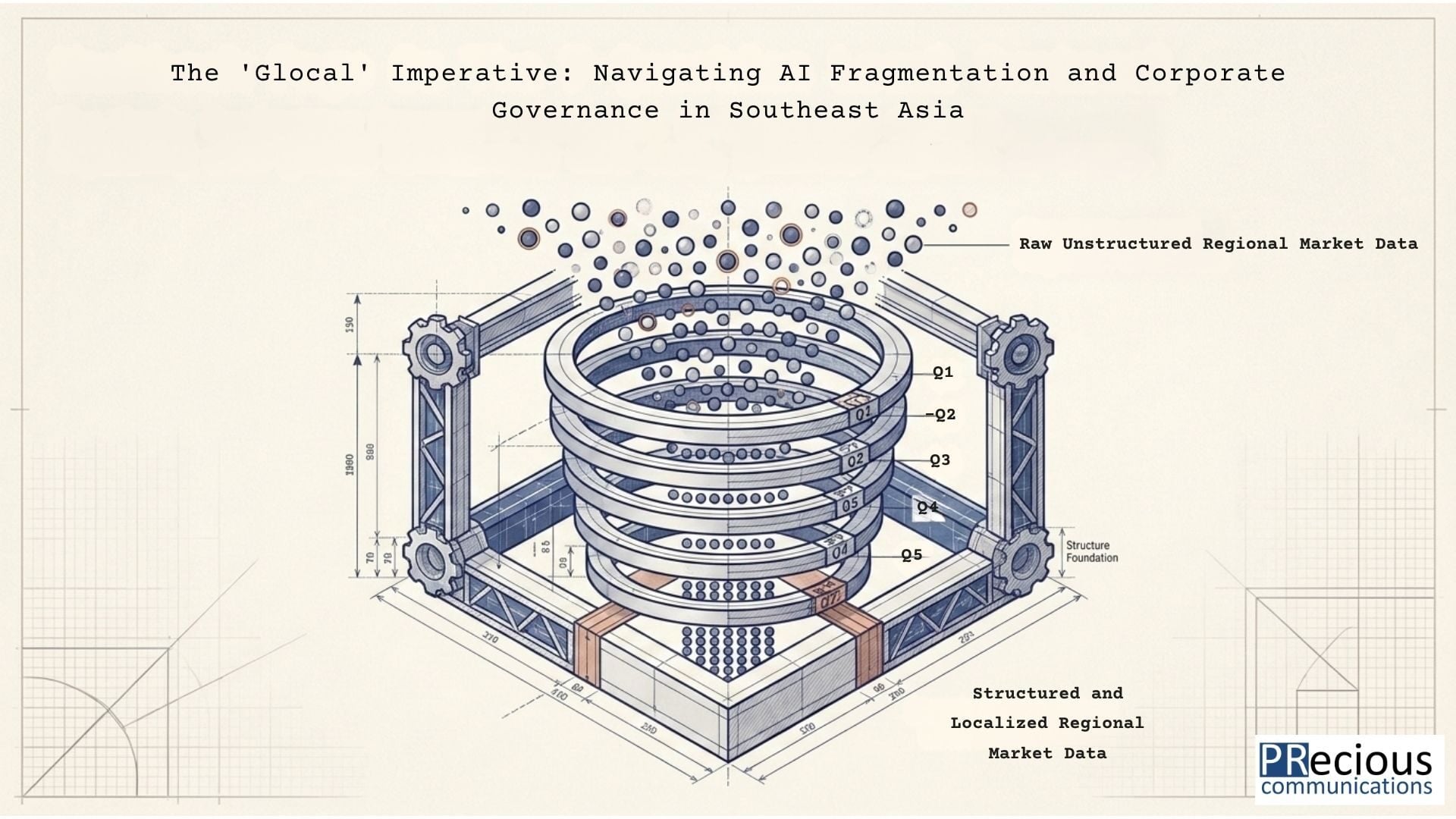
In global development and international business, narratives are often treated as mere communication dressing—creative window-wrapping for dry spreadsheets. However, as the Experiencing Public Relations (EPR) Global Summit Webinar V highlighted, this framing is profoundly outdated.
“Narrative is not a decoration, but economic infrastructure,” declared summit host Angela Kwaa. How a market is narrated directly dictates how it is invested in, partnered with, and respected on the global stage.
For decades, developing nations have been trapped in a deficit-based communication loop. Industry leaders including keynote speaker Jeremy Seow (Chair of Public Relations APAC) , Lars Voedisch (Founder & Group CEO of Precious Communications), and Edinam Afua Adjei Sika (Executive Director of the Brazil-Ghana Chamber of Commerce) came together to outline a vital paradigm shift. They explored how emerging markets must reclaim their stories, leverage PR as an upstream strategic tool, and build sustainable frameworks that withstand the scrutiny of both human investors and artificial intelligence algorithms.
The Strategic Summary
- Scaling via a ‘Glocal’ Playbook: PRecious Communications expanded from a local startup into a multi-market regional consultancy by combining decentralized local leadership across Southeast Asia with unified operational frameworks.
- Earning the ‘Fifth Seat’ in the Boardroom: The agency transitioned from execution-heavy PR to an advisory-led model, positioning communicators to guide C-suite executives directly on high-stakes business challenges like M&As and IPOs.
- ‘Govern First’ AI Integration: By deploying a secure enterprise stack and establishing a mandatory “Human-in-the-Loop” Strategic Pivot, the firm uses AI to gain executional speed while preserving senior consultant oversight.
- Navigating the Intelligence Economy: As search behaviors evolve beyond traditional SEO, the consultancy is expanding its strategy into Generative Engine Optimization (GEO) and Search Experience Optimization (SXO) across modern discovery channels.
Leapfrogging the Hunter’s Frame
To understand the core narrative gap, Lars Voedisch pointed to a powerful African proverb: “Until the lion learns to write, every story will glorify the hunter.” . Historically, emerging markets have been defined strictly by what they lack—dependency, fragmentation, and instability. This occurs because mature, Western-led economies historically established the global benchmarks and reference systems.
Historically, this transition is best understood as a shift between two competing frameworks:
- The Traditional Deficit Lens: Defined by a sense of “catching up” to the West, focusing primarily on hardship, adversity, and dependency.
- The Reclaimed Narrative: Focused on leapfrog models, local relevancy, and high-value output that sets new global standards.
However, emerging economies are not merely catching up; they are actively leapfrogging legacy systems. While established European markets like Germany remain tethered to forty-year-old, underground ISDN cabling, emerging markets have bypassed landlines entirely, constructing systems that are inherently mobile-first and mobile-only.
We are living through a massive global rebalancing accelerated by digital platforms, social media, and shifting trade flows.
Leaders must step into this vacuum of perception. As Edinam Afua Adjei Sika warned, “Silence is also a narrative.”. If an organization or a nation remains silent about its achievements, it tacitly validates the narrow, outdated, and often unhelpful stories told by outside entities.
Confronting the “Emerging Into What?” Fallacy
In his keynote address, Jeremy Seow challenged the very vocabulary of global trade: “Emerging into what? Who decided what the finished version looks like?” . The term “emerging market” inherently suggests a singular linear path of development, where Western markets represent the final destination. Yet, this framework frequently misses reality.
Historically, communicators have relied on lazy Western analogies, describing local innovations as “the Uber of Southeast Asia” or “the Amazon of Africa” . While this shorthand offers an easy reference point for international audiences, it ultimately traps local companies inside someone else’s box.
This “Novelty Gap” highlights the difference between forcing a local innovation into a Western analogy versus recognizing its organic native model. For instance, while a Western approach focuses on digitizing legacy bank branches, the organic native model in emerging markets creates branchless, digital-first banking designed natively around mobile behavior.
In reality, these platforms quickly evolve into comprehensive multi-service ecosystems spanning logistics, financial services, and daily commerce that resemble nothing in the West. For example, fintech in Nigeria is not just a digital skin on top of a traditional bank; it represents bankless, mobile-centric systems designed natively around mobile behaviors from the ground up.
True narrative confidence means stopping the search for external validation. As Lars Voedisch succinctly stated, “Lagos does not need to become London, and Jakarta does not need to become Silicon Valley.”
Moving From “Resilience” to Relevancy
Another common trap is the industry’s reliance on “resilience” narratives. While stories of overcoming adversity and hardship are deeply moving, they shouldn’t be the only lens through which developing regions are viewed.
In mature markets, creators, chefs, tech founders, and eccentric businesses are allowed to exist simply because they are interesting, no one demands to know what macro-developmental problem their night-life brand or subculture solves.
Communicators must transition away from:
- STOP begging for a chance, highlighting a tough journey, or pleading for acknowledgment, which only reinforces vulnerability.
- START demonstrating absolute relevance: “Look what we are building, and why it matters to you.”
This shift was illustrated by the Brazil-Ghana Chamber of Commerce’s agricultural technology trade missions. Rather than approaching Brazilian agribusiness with a “come and help us” appeal, Ghanaian leaders presented peer-to-peer opportunities based on shared climate characteristics and collaborative technology transfer. They moved the conversation from charity to mutual commercial value.
The Strategic Playbook: Association, Focus, and AI Alignment
Shaping an independent corporate narrative requires a tactical playbook built on clear rules:
A. Build Trust via Association
For early-stage startups or local players entering global markets, credibility is scarce. Lars Voedisch advises building immediate authority by associating with established entities such as national ministries, business chambers, or recognized global platforms.
B. Establish a Sharp Point of View
“Trying to be everything to everybody all the time” is a fatal error. To stand out, a brand must champion a distinct, sometimes polarizing point of view. While you will alienate those who would never buy from you anyway, you will build intense loyalty among your true core audience, driving revenue upward.
C. Ensure AI-Era Multi-Channel Alignment
We have entered an era where artificial intelligence engines continuously crawl and index executive LinkedIn posts, media clippings, and website copy to synthesize a singular, condensed “perceived truth” about a brand. If your sales team, CEO, and CTO communicate conflicting messages, AI cannot synthesize a cohesive brand profile and neither can human customers.
Voedisch pointed to the rapid collapse of Silicon Valley Bank as a modern warning: when communications to one stakeholder group are not aligned with others, panic spreads instantly across digital networks, resulting in fatal bank runs.
Investor Storytelling: Excel Sheets Met with Passion
To attract global capital, business leaders must separate “feel-good charity stories” from clear, robust investment pitches. An investment opportunity is a straightforward financial equation evaluated on its risks, returns, and fundamentals. PR cannot compensate for a broken business model; the fundamentals must exist first.
Strategic storytelling serves as the bridge between cold financial models (the abstract numbers) and the human element (enthusiasm and FOMO). By combining these, organizations can move toward a trusted investment decision.
The role of strategic communications is to take abstract financial metrics and render them tangible . For example, rather than simply stating that agricultural yields rose by 40%, storytelling introduces the specific, thriving enterprises driving that yield, clarifying the human proof points behind the data.
Furthermore, reputation building must begin on day one, not when capital is urgently needed. Long-term narrative positioning builds a runway of trust so that when the doors are opened to investors, a solid foundation is already in place. Combine this structural trust with unbridled enthusiasm and a sense of FOMO (Fear of Missing Out) to drive active investor participation.
PR in the Age of AI: Upstream Judgment Over Production
As generative AI tools lower the barrier to downstream production, making drafting, translation, and graphic asset creation instant and cheap, the organization of communication teams must change.
Historically, PR agencies were organized around production bottlenecks. Now, with content becoming hyper-abundant, upstream judgment—the ability to determine what matters, why it matters, and its context—becomes the ultimate differentiator that guides AI-assisted execution.
“Judgment is deciding what matters before deciding what to say,” Jeremy Seow remarked .
Human communicators must act as noticers and historians Because AI systems train on existing digital archives, they inevitably inherit, synthesize, and amplify the outdated, biased, or shallow frames of the past . If the online record of an emerging market is defined primarily by its deficiencies, the AI will continuously reproduce that deficit lens at scale.
Therefore, documenting the “good stuff” like the stories of business innovation, native operating models, and unique cultural contexts is not just a modern marketing tactic. It is a strategic responsibility to feed the global information environment with accurate, forward-looking data that will shape how the world perceives, trusts, and invests in emerging markets for generations to come.
Take Control of Your Narrative with PRecious Communications
At PRecious Communications, we have spent over a decade helping enterprises move beyond outdated legacy frameworks and command their own stories on the global stage. If narrative is economic infrastructure, your business cannot afford to let others write your history or stay silent.
Whether you are seeking to pressure-test your corporate narrative, shift your positioning from “resilient” to “highly relevant,” or prepare your leaders to drive regional transformation, our integrated capabilities are built to deliver:
- From Resilience to Relevancy (Executive Voice & Leadership Branding): Define your unique stance on technology and market leadership. We help your executives stop explaining “how far they have come” and start demonstrating exactly why their native innovations matter to global partners today using customized LinkedIn Profiling and Executive Communication strategies.
- Establish a Distinct Point of View (Reputation & Stakeholder Management): Guard your brand’s integrity by refusing to try and please everyone. We help you build trust by association with established global networks while carving out a sharp, highly differentiated stance that commands market authority and wins fiercely loyal stakeholders.
- Upstream Strategic Judgment & AI Alignment (Content & SEO): Protect your business from the fragmented messaging that triggers digital panic. We align your communications across all channels so that both human investors and crawling LLM algorithms synthesize a cohesive, trust-first “perceived truth” about your brand, utilizing strategic content creation and search model optimization.
- Scale Your Native ASEAN Narrative (Regional Localization): Jakarta doesn’t need to be Silicon Valley, and Bangkok doesn’t need to be London to win. Scale seamlessly by leveraging our deep localization and regional operational frameworks across our offices in Singapore, Indonesia, Malaysia, the Philippines, Vietnam, and Thailand.
Transform Your APAC Communications Strategy
At PRecious Communications, we have spent over a decade helping enterprise brands, hyper-growth startups, and multinational organizations scale across Asia-Pacific with high-impact, advisory-led communications.
Connect with the PRecious Communications team today to stop asking for a chance and start shaping a relevancy-driven, AI-proof narrative for your organization’s digital future.
Connect with Our Regional Market Leads Today