Japan Market Entry: Pairing GEO With Ringi and Nemawashi Consensus
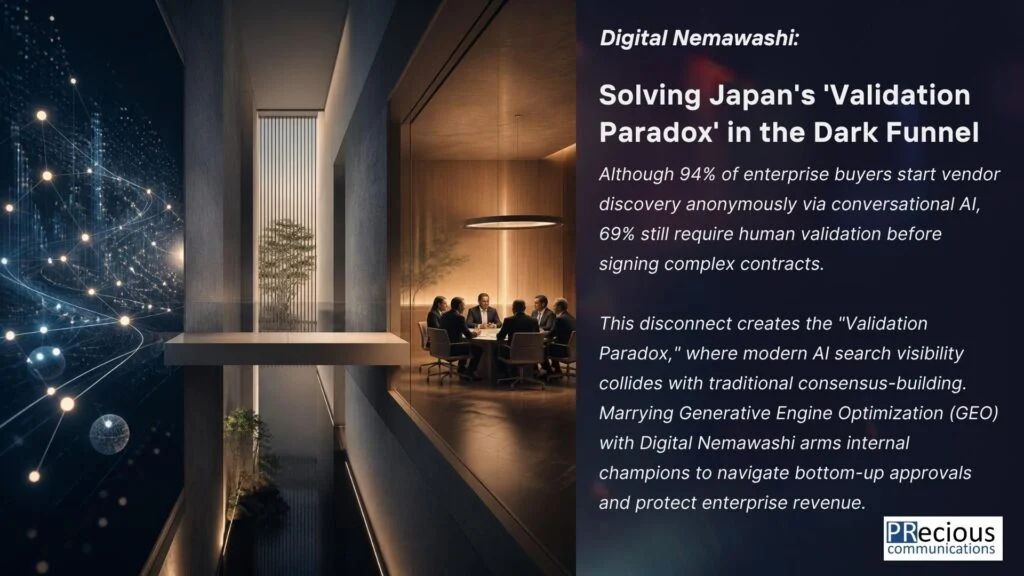
When 94% of B2B buyers evaluate enterprise solutions anonymously through AI, why do 69% still demand human sales validation before signing?
In modern enterprise expansion, market leaders are crashing into The Validation Paradox, a friction point particularly acute in Japan’s risk-averse, consensus-driven buying ecosystem.
In partnership with our Tokyo affiliate, TrainTracks Inc., PRecious Communications has mapped how global entrants must bridge this gap by pairing Generative Engine Optimization (GEO) with Japan's traditional consensus mechanics:
▪️ The Dark Funnel Gateway: Up to 80% of the buying journey happens in private channels and AI answer engines before direct contact. Being recommended by LLMs opens the door, but it doesn't close the deal.
▪️ Arming the Tanto: Enterprise buying in Japan moves bottom-up through Ringi seido (稟議制度). Your internal champion (tanto) needs structured Japanese proposal templates, Yen cost models, and local ROI proof points to navigate internal review committees.
▪️ Digital Nemawashi (根回し): Informal, behind-the-scenes pre-alignment must now happen across Slack, Teams, and virtual pre-meetings to build cross-departmental consensus long before the formal ringisho circulates.
▪️ Compliance as Ammunition: Clearing security reviews requires equipping champions upfront with localized APPI, Global CBPR, and ISMAP compliance documentation.
Winning in Japan requires a dual architecture: win the algorithm to get onto the shortlist, and master the consensus loop to close the deal.
How is your organization supporting internal B2B champions when navigating complex, consensus-driven market entries? Let’s share notes below.
#JapanBusiness #MarketEntry #SXO #GenerativeEngineOptimization #B2BMarketing #WeBePRecious #TrainTracksPR
Lars Voedisch Chip Keng Ng Sunita Kanapathy Paolo Alba Sarah Cavanaugh Ridzki Noviansyah Thanh Hien Pham Busakorn Srisongkhroh